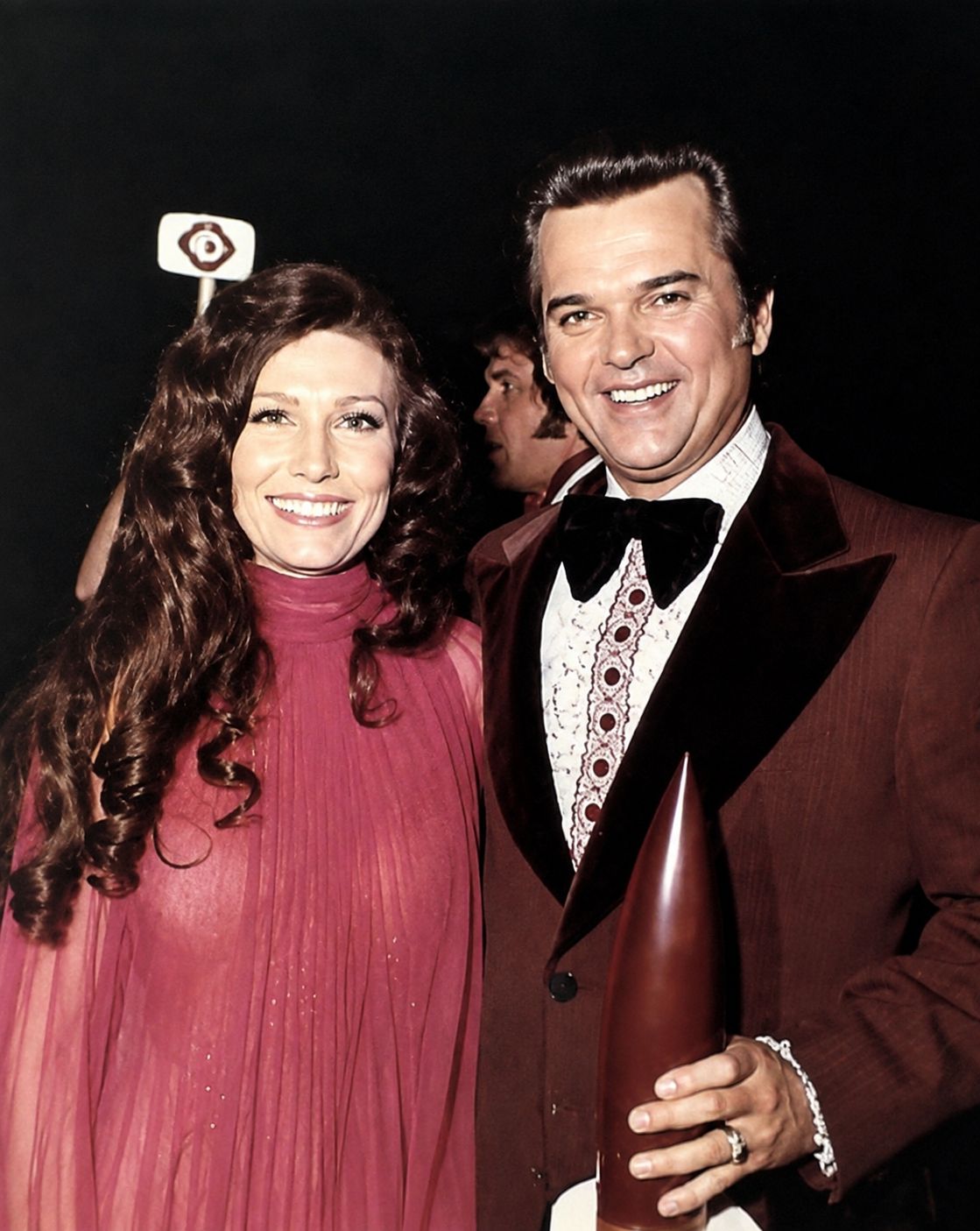
There are country songs that become hits.
There are country songs that become classics.
And then there are songs that seem to create an entire little world every time they play.
“Louisiana Woman, Mississippi Man” belongs in that last category.
When Conway Twitty and Loretta Lynn recorded the song in 1973, they weren’t simply putting two famous voices together. They were creating a conversation between two people who sounded as though they could barely wait for the other to finish singing.
A river stood between them.
Distance stood between them.
Even the exaggerated dangers of the South—alligators, hurricanes, and the mighty Mississippi itself—seemed determined to keep them apart.
But the song had one answer to every obstacle:
Love was stronger.
Released in May 1973 as the first single and title track from their album Louisiana Woman, Mississippi Man, the recording quickly became the duo’s third No. 1 country hit. It eventually spent one week at the top of the Billboard country chart and 13 weeks on the chart overall. (Wikipedia)
But statistics don’t explain why people still remember the song.
For that, you have to listen to the chemistry.
TWO VOICES. ONE RIVER. ONE UNFORGETTABLE LOVE STORY.
Imagine country radio in 1973.
The sound coming through the speakers wasn’t polished in the modern sense. It was alive. There was fiddle, pedal steel, electric guitar, rhythm, and that unmistakable Southern energy.
Then Conway Twitty’s voice arrived.
Deep.
Confident.
Almost conversational.
And suddenly Loretta Lynn answered.
Her voice carried a completely different kind of authority—earthy, sharp, feminine, determined.
The magic wasn’t that they sounded alike.
It was that they didn’t.
Their differences created tension.
Twitty sounded like the man trying to get across the river.
Lynn sounded like the woman who had already decided that nothing was going to stop her from getting to him.
That contrast became the heartbeat of the record.
The song was written by Becki Bluefield and Jim Owen and produced by Owen Bradley. According to the PBS American Masters account, Loretta Lynn later recalled that her husband-manager, Oliver “Doo” Lynn, found the song for the pair. (PBS)
And it turned out to be almost perfectly designed for them.
The premise was wonderfully simple:
A Louisiana woman.
A Mississippi man.
One enormous river between them.
And two people who refuse to accept that geography gets the final word.
“The Mississippi River can’t keep us apart.”
That idea is what made the song so instantly relatable.
Because underneath the playful Southern imagery was something much more universal:
What wouldn’t you do to reach the person you love?
CONWAY TWITTY WASN’T JUST SINGING — HE WAS FLIRTING THROUGH THE MICROPHONE
One of Conway Twitty’s greatest strengths was his ability to make a recording feel intimate.
He didn’t always need to overpower a song.
Sometimes, the less he pushed, the more powerful his presence became.
On “Louisiana Woman, Mississippi Man,” however, he brought a mischievous energy that made the record feel almost like a musical argument between lovers.
He calls out.
Loretta responds.
He pushes forward.
She pushes back.
And suddenly the listener isn’t merely hearing a duet.
They’re eavesdropping on a relationship.
That was one of the secrets of the Twitty-Lynn partnership.
Their recordings often worked because the audience could imagine a story unfolding between the two voices.
PBS notes that Twitty and Lynn made 11 studio albums together between 1971 and 1988, producing five No. 1 songs from five different albums. The pair also won the Country Music Association’s Vocal Duo of the Year award every year from 1972 through 1975. (PBS)
That’s not simply a successful collaboration.
That’s a musical partnership that defined an era.
And “Louisiana Woman, Mississippi Man” may have captured their chemistry better than almost anything else.
LORETTA LYNN MADE THE SONG FEEL FEARLESS
If Conway brought the swagger, Loretta brought the determination.
That’s important because the woman in this song isn’t sitting around waiting for her man to solve everything.
She’s ready to go after him.
That’s classic Loretta.
Throughout her career, Lynn became famous for portraying women who were emotional but never powerless. Her songs could be vulnerable, funny, rebellious, angry, romantic, or brutally honest.
“Louisiana Woman, Mississippi Man” gave her another opportunity to embody that spirit.
The river isn’t presented as an impossible tragedy.
It’s a challenge.
And she’s willing to meet it.
That attitude gives the song its personality.
It isn’t a sad ballad about lovers separated by geography.
It’s a celebration of two people who essentially say:
“Fine. Put a river between us. We’ll cross it anyway.”
That is why the record feels so joyful.
The obstacle makes the love seem bigger.
THE MUSIC SOUNDS LIKE THE SOUTH IS MOVING
One of the most fascinating elements of the recording is its musical momentum.
The song doesn’t drag.
It moves.
Contemporary coverage described it as having an upbeat Cajun influence, with electric guitar, pedal steel and fiddle helping drive the arrangement. (The Boot)
That matters enormously.
A slower arrangement might have turned the song into a sentimental story about separation.
Instead, the instrumentation makes separation sound temporary.
The rhythm practically tells you:
They’re going to find each other.
The musical arrangement also creates room for the personalities of both singers.
The song has the feel of a conversation happening at full speed.
One singer throws a line across the river.
The other throws one back.
Before you know it, the Mississippi isn’t really the main character anymore.
The main character is their chemistry.
WHY AMERICA COULDN’T GET ENOUGH OF THEM
By the time “Louisiana Woman, Mississippi Man” arrived, Conway Twitty and Loretta Lynn had already established themselves as one of country music’s most successful male-female partnerships.
Their first No. 1 duet had been “After the Fire Is Gone” in 1971.
Then came more hits.
More albums.
More awards.
More evidence that something unusual happened whenever their voices met.
But there was something particularly accessible about “Louisiana Woman, Mississippi Man.”
You didn’t need to know the history of country music to understand it.
You didn’t need to analyze complicated lyrics.
You didn’t need to understand Nashville’s recording culture.
You simply heard two people who wanted to be together.
And everyone understands that.
That’s why the song could feel both distinctly Southern and completely universal.
THE SECRET WAS THAT THEY SOUNDED LIKE REAL PEOPLE
Many duets can feel carefully constructed.
This one felt spontaneous.
That’s the difference between hearing two singers and hearing two characters.
Conway wasn’t just Conway.
He became the Mississippi man.
Loretta wasn’t simply Loretta.
She became the Louisiana woman.
The geographical labels made the story bigger while somehow making the relationship feel smaller and more personal.
It was almost like listening to two neighbors shouting affection across a river.
And that theatrical quality is one reason the song has survived.
Country music has always understood the power of storytelling.
The greatest country songs don’t simply tell you what happened.
They make you feel as though you were standing there.
“Louisiana Woman, Mississippi Man” does exactly that.
MORE THAN 50 YEARS LATER, THE CHEMISTRY STILL WORKS
Perhaps the strongest proof of the song’s staying power is what happened long after Conway Twitty and Loretta Lynn were gone.
Their musical legacy continued through their families.
Tre Twitty and Tayla Lynn—grandchildren of Conway and Loretta—later formed their own duo, Twitty & Lynn, recording new versions of songs associated with their grandparents, including “Louisiana Woman, Mississippi Man.” (Southern Living)
That’s more than nostalgia.
It’s musical inheritance.
A song written by two people who weren’t even the performers became part of a family story spanning generations.
And that tells us something important about classic country music.
The best songs don’t belong entirely to the people who recorded them.
Eventually, they belong to everyone who heard them.
They become wedding memories.
Road-trip memories.
Saturday-night memories.
Memories of parents and grandparents.
Memories of a time when a voice on the radio could instantly transport you somewhere else.
THE REAL REASON THIS SONG STILL HITS SO HARD
Maybe it isn’t the river.
Maybe it isn’t the fiddle.
Maybe it isn’t even the legendary voices of Conway Twitty and Loretta Lynn.
Maybe it’s the simple promise underneath everything.
Distance doesn’t have to win.
In an era when relationships can be separated by cities, states, oceans, schedules, careers, and countless other obstacles, that message still feels surprisingly modern.
The Mississippi River becomes a metaphor.
The alligators become a joke.
The hurricane becomes another obstacle.
And love becomes the thing that keeps moving.
That’s why the song doesn’t feel old.
It feels human.
And Conway Twitty and Loretta Lynn understood something that many singers spend an entire career trying to discover:
Chemistry cannot be manufactured.
You can write a great melody.
You can hire great musicians.
You can build a perfect studio arrangement.
But when two voices genuinely seem to want to hear each other, listeners notice.
That’s what happened here.
Two legendary country singers stepped up to the microphone and turned a river into a love story.
They turned geography into flirtation.
They turned separation into excitement.
And they turned a simple song into one of the most memorable country duets of the 1970s.
More than half a century later, the opening notes still carry that same feeling.
You hear Conway.
You hear Loretta.
And suddenly you’re back there.
Somewhere along the Mississippi.
Somewhere between Louisiana and Mississippi.
Somewhere in the golden age of country music.
And for three unforgettable minutes, nothing—not even the river—can keep these two lovers apart.
That is the magic of “Louisiana Woman, Mississippi Man.”
Not just a hit.
Not just a duet.
A little piece of country music history that still feels alive. (conwaytwitty.com)
Video