Introduction
In 1958, the world watched something almost unimaginable happen to the biggest star on Earth.
Not a scandal.
Not a breakdown.
Not a retirement.
But a goodbye.
When Elvis Presley entered the U.S. Army on March 24, 1958, millions of fans felt like they had lost a piece of themselves. Teenagers cried openly in train stations. Newspapers printed emotional headlines. Radio DJs spoke as if a national tragedy had unfolded.
The King of Rock and Roll was leaving the stage.
And for many Americans, it felt like the music had suddenly gone silent.
The Boy Who Changed America Overnight
By 1958, Elvis Presley was no longer just a singer. He was a cultural earthquake.
Only a few years earlier, he had been a shy truck driver from Memphis with a strange voice, slick hair, and movements that shocked older generations. But suddenly, every teenager in America wanted to dress like him, sing like him, and move like him.
Parents feared him.
Church leaders criticized him.
Young fans worshipped him.
Elvis represented freedom, rebellion, youth, and desire all wrapped into one human being.
Songs like Heartbreak Hotel, Hound Dog, and Jailhouse Rock turned him into something bigger than music. He became the emotional center of an entire generation.
Then came the announcement no one expected.
Elvis Presley had been drafted.
“How Could They Take Elvis From Us?”
The reaction was immediate and emotional.
Fans flooded newspapers with letters begging the government to spare him. Some believed America needed Elvis more than the Army did. Others could not imagine the world continuing normally without him performing every week.
One teenage fan reportedly said:
“It feels like they’re taking away our happiness.”
And honestly, that wasn’t an exaggeration.
In the late 1950s, Elvis wasn’t just entertainment. For many young people, he represented escape from strict parents, fear of war, and the pressure of post-war American life.
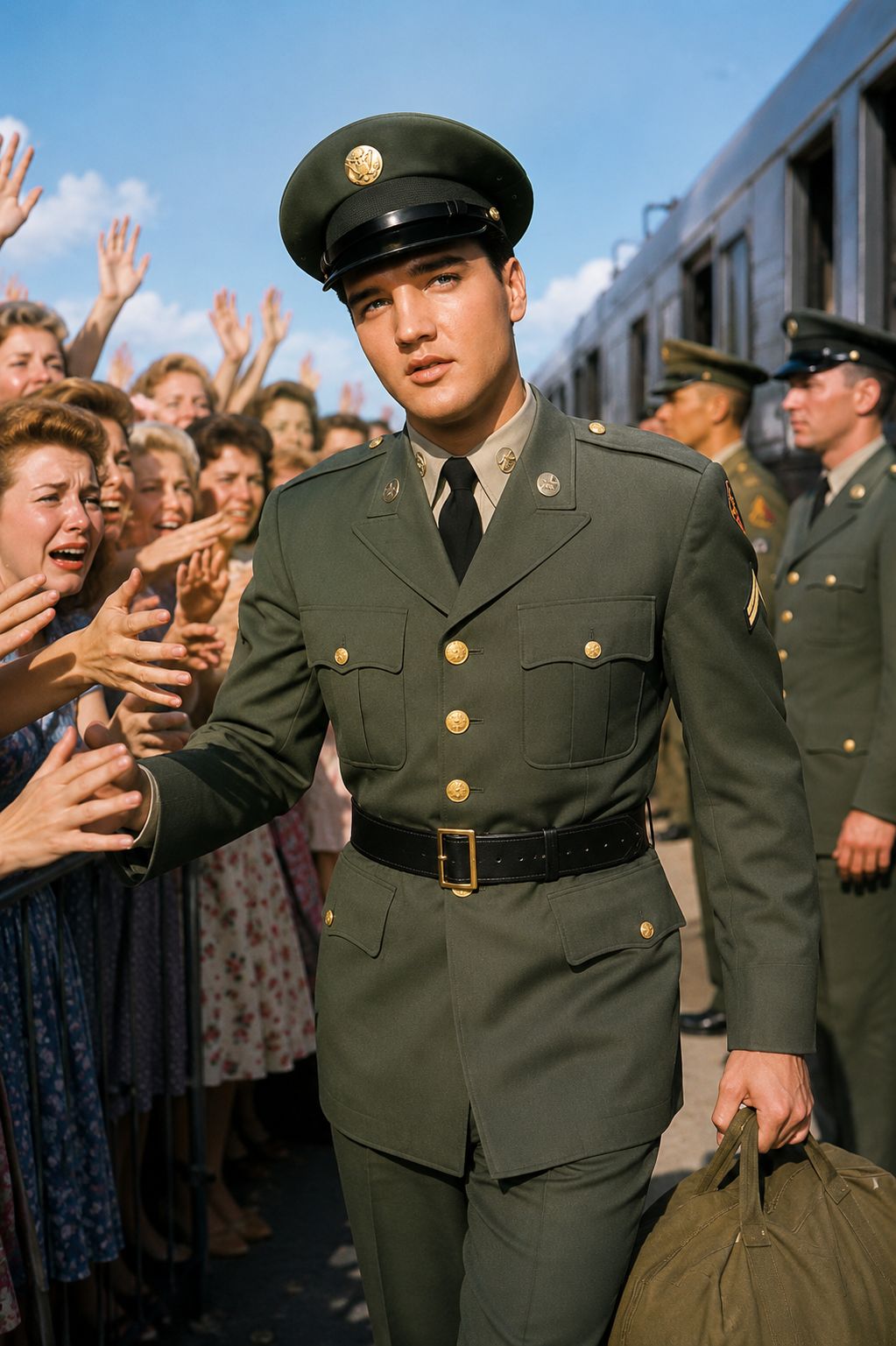
When he boarded the train to begin military service, girls screamed and cried behind barricades. Some fainted. Some held signs saying:
“Come back to us, Elvis.”
The images became iconic.
A young superstar in uniform.
A nation emotionally shattered behind him.
The Most Famous Soldier in America
Many celebrities at the time found ways to avoid military service. Elvis could have tried.
He didn’t.
That decision changed how millions viewed him forever.
Instead of demanding special treatment, Elvis chose to serve as a regular soldier. The U.S. Army even offered him opportunities to enter Special Services — essentially performing safely for troops instead of standard duty.
Elvis refused.
He wanted to be treated like every other young American man.
And suddenly, the rebellious rock star parents feared became something else entirely: a symbol of patriotism and humility.
Older Americans who once hated Elvis began respecting him.
Colonel Tom Parker, Elvis’s manager, understood the power of this transformation immediately. Before the Army, Elvis had been controversial. During and after the Army, he became acceptable to mainstream America.
But behind the public image was something much heavier.
Elvis himself was terrified.
Fame Could Disappear Overnight
Today, it’s hard to imagine Elvis Presley being forgotten.
But in 1958, the entertainment industry moved brutally fast. Careers disappeared within months. New singers arrived every week. Trends changed constantly.
Elvis feared the Army would destroy everything he had built.
What if fans forgot him?
What if another singer replaced him?
What if “Elvis Presley” became yesterday’s news?
He reportedly worried about this constantly before leaving.
And there was another pain hidden beneath the headlines.
His mother, Gladys Presley, was devastated by his departure.
The bond between Elvis and Gladys was extraordinarily deep. Friends described them as emotionally inseparable. Elvis often said she was the most important person in his life.
When he entered the Army, she reportedly cried endlessly.
And only months later, tragedy struck.
The Heartbreak That Changed Elvis Forever
In August 1958, while Elvis was still in military service, Gladys Presley died at just 46 years old.
Elvis collapsed emotionally.
Witnesses described him throwing himself onto her coffin in grief. Some said they had never seen a human being so broken.
“Everything I have is gone,” Elvis reportedly whispered.
Many historians believe this moment permanently changed him.
Before the Army, Elvis radiated youthful energy and wild excitement. After losing his mother, something darker entered his spirit. The carefree young rebel America first fell in love with never fully returned.
And yet, even through grief, Elvis continued serving.
That image — the biggest celebrity in the world standing in uniform while privately falling apart — only deepened America’s emotional connection to him.
Germany, Loneliness, and a New Elvis
Elvis was eventually stationed in Germany, far away from the screaming crowds of America.
For the first time in years, he experienced something close to ordinary life.
No giant stages.
No movie premieres.
No hysterical fans surrounding every building.
Just military routines, long nights, and isolation.
Ironically, that distance may have saved him.
Friends later said the Army gave Elvis discipline and structure at a time when fame could have destroyed him completely.
But Germany also introduced him to people and habits that would shape the rest of his life — including the beginning of his relationship with prescription medications.
It was also in Germany where Elvis met a young girl named Priscilla Presley.
Neither realized then how deeply their lives would become intertwined.
America Waited… and Waited
Back home, fans counted the days until Elvis would return.
Magazines constantly published updates about his military service. Radio stations replayed old songs endlessly. Fan clubs organized prayer groups and countdowns.
It sounds unbelievable today, but America genuinely missed Elvis like a missing family member.
Because nobody else felt like him.
Other singers could imitate the voice.
Others could copy the hairstyle.
But nobody carried the same emotional electricity.
Even while serving overseas, Elvis remained the center of American pop culture.
And when he finally returned home in 1960, the hysteria exploded all over again.
Only this time, Elvis Presley was no longer just a rebellious young rock star.
He was bigger.
More mature.
More respected.
More tragic.
The Goodbye That Made Elvis Immortal
Ironically, entering the Army may have been the moment Elvis Presley became truly untouchable.
Before military service, critics called him dangerous. After military service, he became an American icon.
The heartbreak of 1958 created a myth around him that only grew stronger with time.
Fans never forgot the images:
- Elvis saluting in uniform.
- Teenage girls crying uncontrollably.
- A superstar quietly grieving his mother.
- America waiting for its King to return.
And perhaps that is why the story still resonates nearly seventy years later.
Because deep down, it was never just about music.
It was about losing innocence.
When Elvis entered the Army in 1958, millions of young fans felt childhood slipping away. The wild excitement of early rock and roll suddenly collided with adulthood, duty, sacrifice, and heartbreak.
For the first time, the invincible Elvis Presley looked human.
And somehow, that made people love him even more.
The world thought the Army was taking Elvis away forever.
Instead, it transformed him into a legend that would outlive generations.
Video