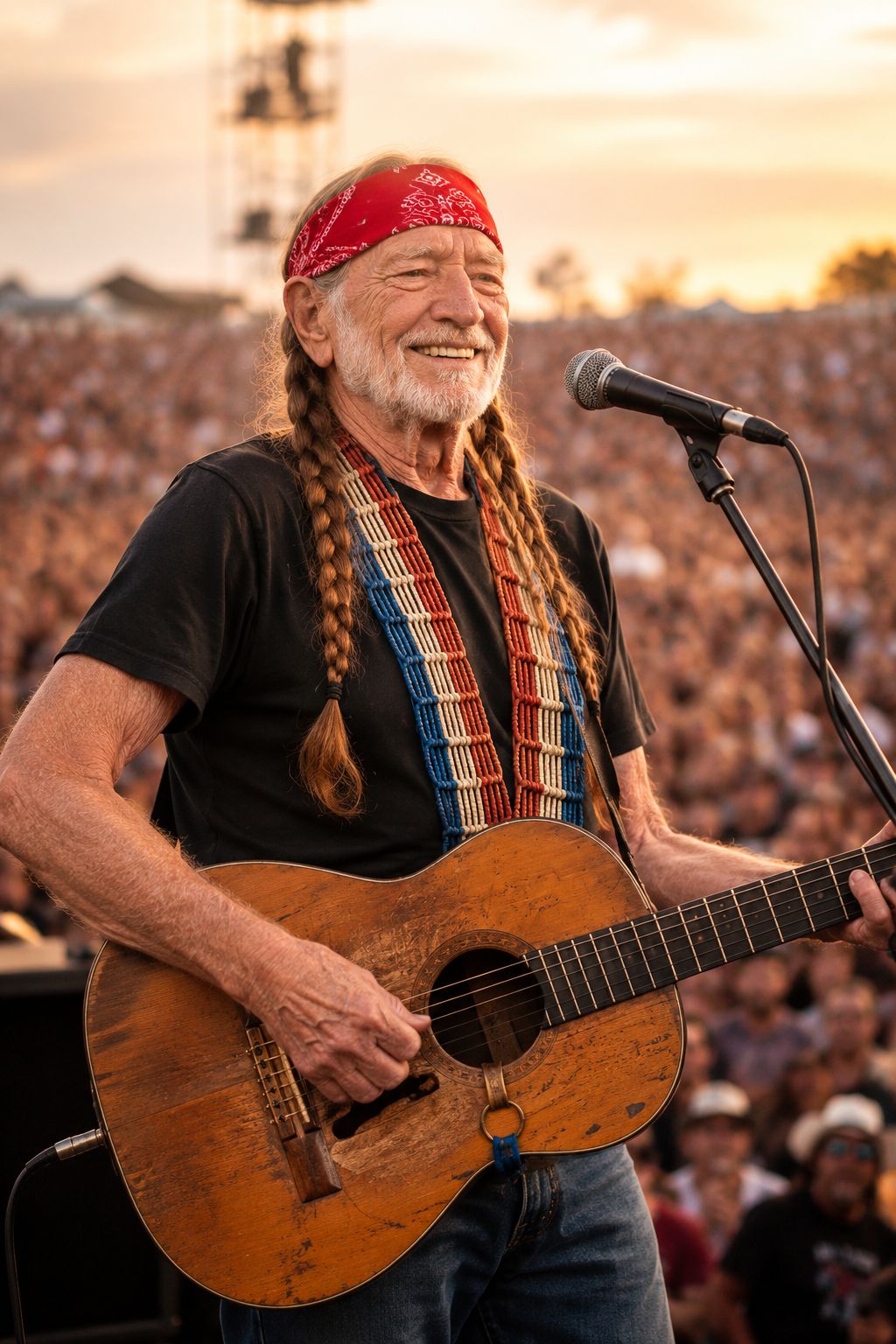
Introduction
In 1980, America was tired.
The country was limping out of the chaos of the 1970s — economic fear, cultural division, broken trust in institutions, and a generation of working people wondering whether anyone still understood them. Factory towns were fading. Farmers were struggling. Veterans carried invisible scars. And somewhere between Nashville’s polished studios and the dusty highways of Texas, one man with braided hair, a battered guitar, and a weathered voice stepped forward and somehow made millions feel seen.
That man was Willie Nelson.
By 1980, Willie Nelson wasn’t just a country singer anymore.
He had become something far bigger.
He became the voice of ordinary Americans who felt forgotten.
At first glance, Willie didn’t even look like a star.
Nashville executives once believed he was too rough, too unconventional, too different to ever become mainstream. His voice cracked. His phrasing ignored the rules. His image looked more like a wandering drifter than a polished celebrity.
But that was exactly why people trusted him.
He didn’t sound manufactured.
He sounded real.
And in 1980, realness mattered more than perfection.
“Willie Nelson didn’t sing at people. He sang with them.”
That distinction changed everything.
While many artists chased glamour, Willie carried the emotional weight of the working class. His songs felt lived-in — like conversations shared at 2 a.m. over coffee in a roadside diner. He sang about heartbreak, loneliness, freedom, regret, survival, and the quiet dignity of people simply trying to make it through life.
America heard itself in his music.
The rise of Willie Nelson in 1980 wasn’t an overnight explosion. It was the payoff of decades of struggle.
Long before sold-out arenas and national fame, Willie had spent years as an outsider. He wrote songs that other artists turned into hits while he remained largely invisible. He lived broke. He battled rejection. Nashville executives tried to mold him into something cleaner and safer.
But Willie refused.
Instead of changing himself, he walked away.
That decision became legendary.
Leaving Nashville’s strict system behind, Willie returned to Texas and embraced the outlaw country movement alongside artists like Waylon Jennings. Together, they challenged the polished sound dominating country radio.
Outlaw country wasn’t just music.
It was rebellion.
It told listeners they didn’t have to fit into society’s neat little boxes to matter.
By the time 1980 arrived, Willie Nelson had become the movement’s beating heart.
Then came the songs that defined an era.
When Willie sang “On the Road Again,” it wasn’t merely a catchy tune. It became an anthem for dreamers, drifters, truckers, musicians, and ordinary workers chasing something better beyond the horizon.
The song captured freedom in its purest form.
“The life I love is making music with my friends…”
Simple words.
But millions heard something deeper.
They heard hope.
They heard escape.
They heard a man who still believed life was worth living despite all its pain.
And perhaps no song revealed Willie’s emotional power more than “Always on My Mind.”
Released in the early 1980s, the ballad felt painfully intimate — a confession from someone haunted by love lost and words left unsaid. Willie’s fragile delivery transformed the song into something devastatingly human.
He didn’t perform the lyrics.
He carried them like emotional scars.
“Maybe I didn’t love you quite as often as I could have…”
That line shattered people because it sounded honest.
Not perfect.
Honest.
And honesty became Willie Nelson’s superpower.
What made Willie extraordinary was his ability to connect across generations.
Older Americans saw him as authentic in a rapidly changing world. Younger listeners viewed him as rebellious and fearless. Farmers respected him. Hippies embraced him. Country traditionalists loved him. Rock fans admired him.
Almost nobody else in music could bridge those worlds.
In 1980, America was deeply divided culturally and politically, yet Willie Nelson somehow became a rare figure nearly everyone could agree on.
Why?
Because he never acted superior.
He never pretended to have all the answers.
He simply told the truth through music.
And people were starving for truth.
There was also something deeply comforting about Willie’s presence.
His weathered face, relaxed smile, and calm demeanor made him feel less like a celebrity and more like someone’s uncle, neighbor, or old friend. Fans didn’t worship him from a distance.
They felt like they knew him.
That emotional accessibility turned Willie Nelson into more than a musician.
He became a symbol of resilience.
By 1980, many Americans were exhausted by fake promises and polished public figures. Willie represented the opposite. He was flawed, vulnerable, open about his struggles, and entirely himself.
That authenticity created one of the deepest emotional bonds in music history.
Behind the fame, however, Willie carried pain most fans never fully saw.
Years of hardship had shaped him long before success arrived. Poverty, heartbreak, financial troubles, and endless rejection hardened him — but they also gave his music emotional gravity.
Every wrinkle in his voice sounded earned.
Every lyric felt believable.
You could hear life inside his songs.
That’s why even people who weren’t traditional country fans connected with him emotionally. Willie Nelson tapped into universal human experiences: loneliness, longing, regret, freedom, forgiveness.
He understood sadness without becoming cynical.
And that balance made his music timeless.
By the early 1980s, Willie Nelson was everywhere.
Television appearances.
Sold-out tours.
Hit records.
Movie roles.
National recognition.
Yet somehow, fame never erased the humble spirit people loved about him.
That may have been his greatest achievement of all.
Because history is filled with stars who became unreachable after success. Willie became even more relatable.
He still looked like the guy who might sit beside you at a roadside bar and tell stories until sunrise.
The cultural impact of Willie Nelson during that period cannot be overstated.
He helped redefine country music itself.
Before Willie and the outlaw movement, Nashville often prioritized polished production and carefully controlled images. Willie helped tear down those walls. He proved artists could succeed by embracing individuality rather than hiding it.
Modern country music — with its emphasis on authenticity and personal storytelling — owes an enormous debt to Willie Nelson.
But his legacy extends beyond music.
In many ways, Willie became the emotional conscience of rural America.
He gave dignity to ordinary people whose stories were often ignored by mainstream culture.
And he did it without bitterness.
Perhaps that is why his music still resonates decades later.
Because Willie Nelson never chased trends.
He chased truth.
And truth rarely expires.
Even today, listening to Willie’s 1980-era music feels like opening an old letter filled with memories, heartbreak, and hard-earned wisdom. His songs remind listeners that vulnerability is not weakness. That pain can coexist with hope. That imperfect people still deserve love.
Most importantly, Willie Nelson reminded an entire generation that they were not alone.
“There’s a freedom you begin to feel the closer you get to Austin, Texas.”
That famous Willie spirit — restless, searching, compassionate, honest — became the heartbeat of millions who saw themselves reflected in him.
By 1980, Willie Nelson wasn’t simply making music anymore.
He was carrying the emotions of a generation on his shoulders.
And somehow, with nothing more than an old guitar and a fragile voice, he made America feel understood.