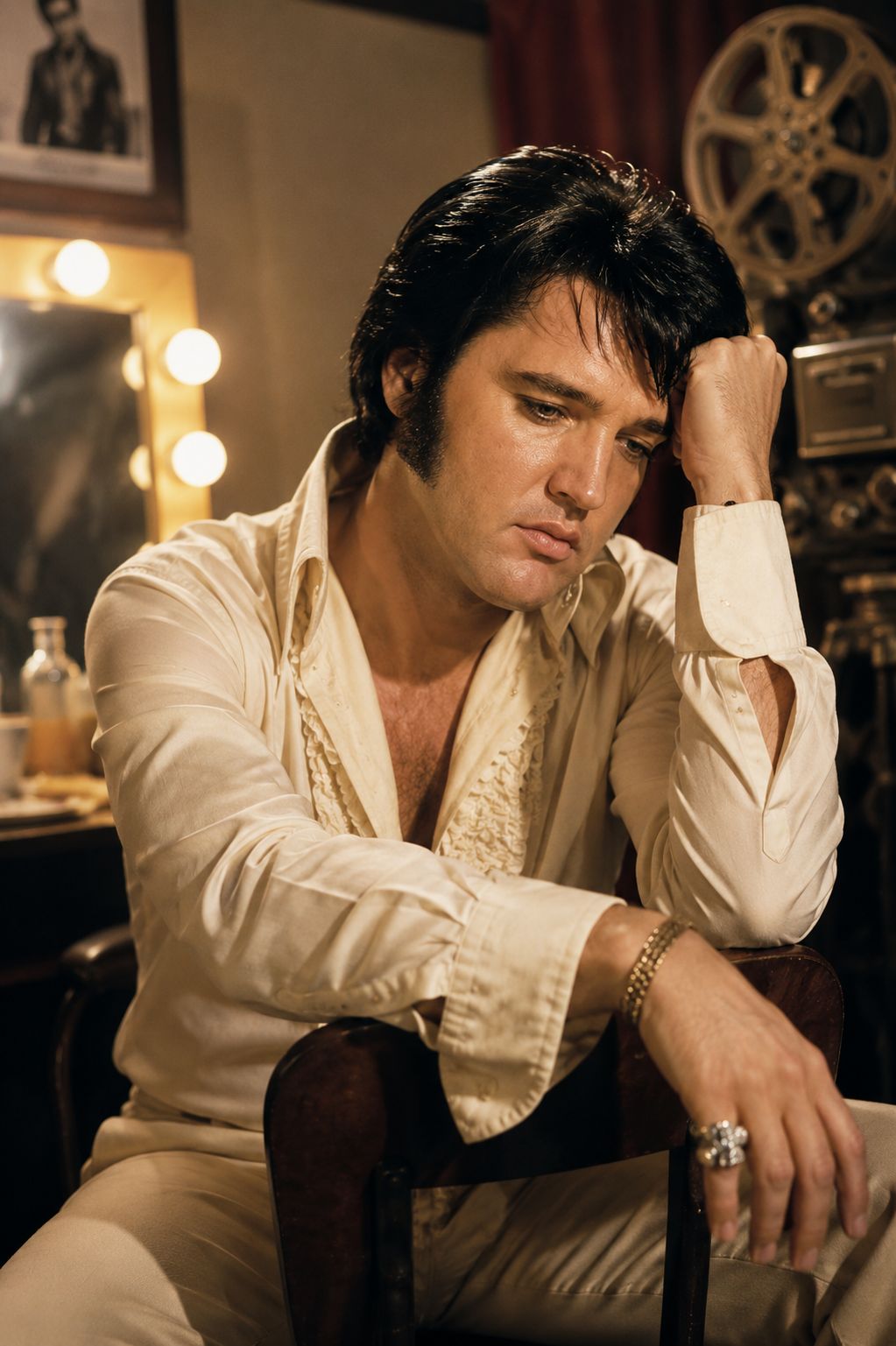
Introduction
The world saw the flashbulbs.
The screaming fans.
The Hollywood premieres.
The gold records.
The impossible smile.
But behind the cameras, behind the velvet curtains of fame, there was another side of Elvis Presley that few people truly understood.
A lonely man trapped inside the very dream he created.
By the 1960s, Elvis wasn’t just a singer anymore — he was a global phenomenon. Hollywood wanted him. Studios built entire movies around his name because they knew audiences would buy tickets just to watch him smile for 90 minutes. Film after film rolled out like clockwork: beach scenes, fast cars, romance, catchy songs, and the same carefully controlled image.
To the public, it looked like paradise.
But the deeper Elvis moved into Hollywood, the more isolated he became.
“The loneliest people are often the ones who make everyone else happy.”
That quote could have been written about Elvis.
Friends close to him later described a man who often felt disconnected from the world around him. He was surrounded by people every day — managers, bodyguards, co-stars, reporters, fans — yet genuine connection became increasingly rare. Everyone wanted something from Elvis Presley. Very few people simply wanted Elvis the human being.
And that loneliness quietly followed him from movie set to movie set.
At first, Hollywood felt exciting. After conquering music, Elvis believed acting might become his next great artistic challenge. He admired serious actors and dreamed of making meaningful films. He wanted to be respected, not just adored.
But Colonel Tom Parker had other plans.
The formula became painfully repetitive. Studios pushed Elvis into lightweight musicals because they guaranteed profits. The scripts blurred together. Exotic locations. Pretty actresses. Predictable endings. Fast production schedules. Little artistic freedom.
The King of Rock and Roll became a product.
And deep inside, Elvis knew it.
“He wanted to do more… but they kept giving him the same movie over and over again.”
That frustration slowly turned into emotional exhaustion.
There were moments on set when Elvis would joke around with cast members and musicians, making everyone laugh. He could light up a room instantly. But when filming stopped and the crowds disappeared, silence often filled the space around him.
Hollywood fame created a strange prison.
The bigger Elvis became, the less normal his life could be.
He couldn’t walk into restaurants freely. He couldn’t form relationships without wondering who he could trust. Even romance became complicated under the weight of worldwide celebrity. Every move became public property.
People loved the image of Elvis Presley.
But who truly understood the man underneath it?
During long nights in hotel rooms and at Graceland, Elvis often stayed awake until sunrise. Friends recalled how he hated being alone with his thoughts. Music helped. Conversation helped. Laughter helped. But eventually, the noise faded.
And loneliness returned.
One of the saddest truths about Elvis’s Hollywood years is that success didn’t bring him the fulfillment he expected. He had money beyond imagination. Fame beyond comprehension. Millions worshipped him.
Yet emotionally, he often seemed to drift further away from peace.
The movies became symbolic of that contradiction.
On screen, Elvis looked carefree and untouchable.
Off screen, he was increasingly searching for meaning.
He explored spirituality deeply. He read books about religion, philosophy, and self-discovery. Those close to him said he constantly searched for answers bigger than fame itself. It was as if he understood that applause could never heal emptiness.
And perhaps that realization frightened him.
Because once someone reaches the top of the mountain and still feels lonely… where do they go next?
“Fame gave Elvis the world — but it also took the world away from him.”
There’s a haunting sadness when watching some of Elvis’s later films today. Not because he lacked charisma — he still possessed enormous star power — but because you can sometimes glimpse exhaustion behind his eyes.
A quiet heaviness.
As if part of him knew he was becoming trapped inside a version of himself he no longer recognized.
The tragedy is that Elvis never stopped giving to people.
Even when emotionally drained, he still performed.
Still smiled.
Still signed autographs.
Still entertained millions.
That’s what made audiences love him so deeply.
He carried his pain privately.
And many artists do exactly the same.
Behind legendary performers, there is often enormous emotional sacrifice. The public sees glamour, but not the sleepless nights. Not the pressure. Not the isolation. Not the fear of disappointing the world.
Elvis carried all of that weight while trying to remain “The King.”
By the late 1960s, something inside him finally pushed back.
The 1968 Comeback Special changed everything.
For the first time in years, audiences saw a different Elvis — raw, passionate, alive again. Dressed in black leather with nothing to hide behind, he looked liberated. The hunger returned to his voice. The fire returned to his performance.
It wasn’t just a musical comeback.
It was a man trying to rediscover himself.
And perhaps that’s why those performances still hit so hard decades later. They feel real. Vulnerable. Human.
Not manufactured Hollywood fantasy.
For a brief moment, Elvis escaped the loneliness that had followed him through the movie years.
He connected again — not to fame, but to music.
“When Elvis sang from pain, the world believed every word.”
That emotional honesty is why his legacy remains immortal.
People don’t just remember Elvis because he was famous. They remember him because beneath the superstardom, there was visible humanity. Imperfection. Fragility. Longing.
Fans recognized pieces of themselves inside him.
And maybe that’s why his story still breaks hearts today.
Because despite all the wealth, beauty, and success surrounding him, Elvis Presley experienced something painfully universal:
The fear of being alone.
Not physically alone.
Emotionally alone.
The kind of loneliness that no crowd can cure.
Even now, decades after his passing, millions continue visiting Graceland searching for traces of the man behind the legend. They come for the music, the memories, the history — but they stay because Elvis’s story feels deeply human.
A boy from Tupelo who conquered the world… yet quietly struggled with the cost of that victory.
And perhaps that is the most heartbreaking part of all.
The movies made Elvis larger than life.
But behind the cameras was a man desperately trying not to lose himself.
“Sometimes the brightest stars burn in the darkest silence.”
That silence followed Elvis Presley for years.
And when we look past the fame, the films, and the screaming crowds, we finally see the truth:
The King was loved by millions…
…but still searching for someone who truly understood him.