Introduction
Some legends are built over decades.
Others are born in a single room.
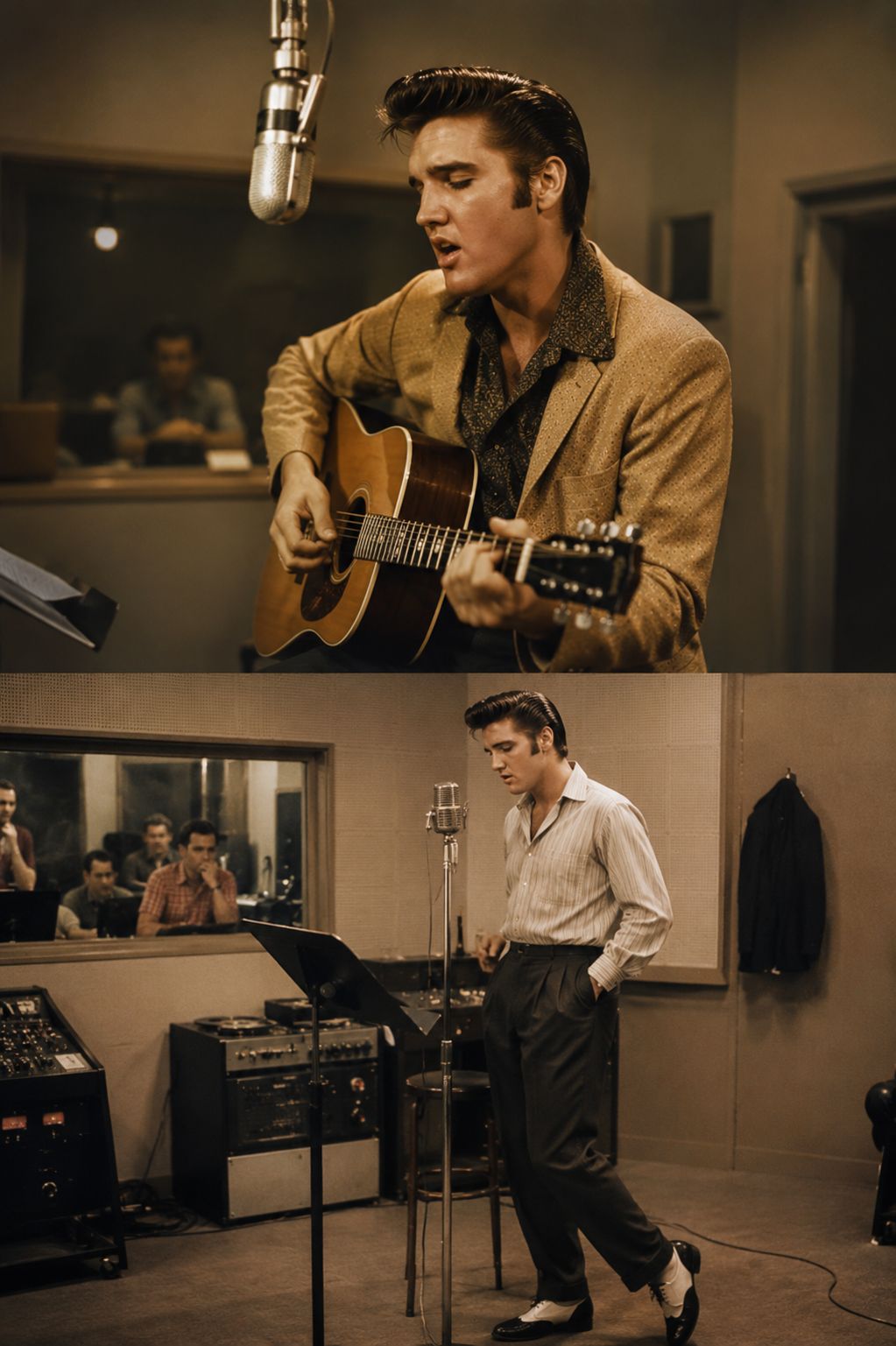
Long before sold-out arenas, Hollywood spotlights, and screaming crowds shook the foundations of American music, there was a nervous young truck driver standing inside a tiny recording studio on Union Avenue in Memphis. The room was small. The equipment was modest. Nobody there could have imagined that history was quietly preparing to change direction.
Yet that day, one sentence captured everything that would follow.
“I don’t sound like nobody.”
It wasn’t arrogance.
It wasn’t rebellion for rebellion’s sake.
It was something far more powerful.
It was identity.
And Elvis Presley never let go of that promise.
The Boy Nobody Could Quite Understand
In the early 1950s, the music industry loved categories.
Country belonged in one box.
Blues belonged in another.
Gospel stayed inside church walls.
Pop artists were expected to sound polished, predictable, and familiar.
Record executives weren’t looking for someone impossible to classify.
They wanted the next version of someone who had already sold records.
Elvis didn’t fit.
He had grown up absorbing every sound around him. Sunday mornings were filled with heartfelt gospel harmonies. Saturday nights echoed with country radio. Memphis streets pulsed with rhythm and blues. Every influence settled somewhere inside his voice until they became impossible to separate.
That made him fascinating.
It also made him difficult.
How do you market someone who refuses to sound like everyone else?
The answer, at first, was simple.
You don’t.
Sun Studio Wasn’t Looking for a Revolution
When Elvis first walked into the modest Memphis studio, nobody rolled out a red carpet.
There were no photographers.
No television cameras.
No record executives betting millions.
Just a young man paying to record a song for his mother.
Sometimes history hides inside ordinary moments.
Producer Sam Phillips had spent years searching for a white singer who could authentically capture the emotional depth and rhythmic power of Black music while remaining unmistakably himself.
He wasn’t searching for imitation.
He was searching for honesty.
When Elvis eventually returned to record professionally, the sessions were awkward.
Songs came and went.
Nothing felt right.
Hours passed.
Frustration settled into the room.
Then something unexpected happened.
During a break, Elvis began fooling around with Arthur Crudup’s blues classic “That’s All Right.”
He wasn’t performing.
He wasn’t trying to impress anyone.
He was simply being himself.
Everything changed.
“What are you doing?”
The famous question reportedly came almost immediately.
Whatever Elvis had stumbled into, everyone in the room knew it was different.
Not polished.
Not perfect.
But alive.
The Voice That Refused to Choose
Many artists spend entire careers searching for a signature sound.
Elvis discovered his by refusing to choose only one.
Listen carefully to those earliest recordings.
Country phrasing slips effortlessly into blues rhythms.
Gospel emotion rises through rockabilly energy.
Nothing feels forced.
Nothing sounds manufactured.
Instead, every influence becomes part of one unmistakable voice.
That is precisely why no one could imitate him.
Many singers copied the hairstyle.
Thousands copied the stage movements.
Countless performers borrowed the clothes.
Almost none could duplicate the sound.
Because the sound wasn’t a formula.
It was a lifetime of musical experiences blended into one unforgettable voice.
Critics Heard Confusion. Fans Heard Freedom.
Every generation has gatekeepers.
When Elvis arrived, plenty of critics simply didn’t know what to call him.
Was he country?
Was he rhythm and blues?
Was he pop?
Was he rock and roll?
The answer was somehow all of them—and none of them.
That uncertainty became one of his greatest strengths.
Young listeners weren’t interested in labels.
They recognized something far more important.
Authenticity.
For teenagers coming of age in postwar America, Elvis sounded like possibility itself.
He represented a future where rules could bend.
Where traditions could evolve.
Where individuality mattered more than fitting into expectations.
That message resonated far beyond music.
Confidence Without Pretending
One remarkable aspect of Elvis’s famous statement is its simplicity.
“I don’t sound like nobody.”
Notice what he didn’t say.
He didn’t claim to be the greatest singer alive.
He didn’t declare himself better than established stars.
He didn’t insult anyone else’s talent.
He merely recognized something unique about himself.
That’s an entirely different kind of confidence.
Real confidence isn’t built by comparing yourself to others.
It’s built by understanding what only you can offer.
Elvis understood that instinctively.
Perhaps that’s why audiences trusted him so quickly.
He wasn’t pretending to become someone else.
He wasn’t wearing another artist’s identity.
He was introducing the world to his own.
The Ripple That Changed Music Forever
The tiny Memphis studio could never have predicted its influence.
From those modest sessions emerged a musical earthquake whose aftershocks still shape artists today.
Without Elvis’s fearless fusion of styles, would rock and roll have exploded quite the same way?
Would countless future musicians have felt empowered to ignore genre boundaries?
Would artists have dared to blend traditions instead of protecting them?
History rarely offers simple answers.
But it does reveal unmistakable patterns.
Elvis proved that originality could become commercial.
He proved audiences were willing to embrace something unfamiliar.
Most importantly, he proved that authenticity could become timeless.
More Than a Quote
Decades later, the sentence still echoes because it speaks to something universal.
Everyone, in some way, faces pressure to fit expectations.
To sound like everyone else.
To follow proven paths.
To become easier to understand.
Elvis chose another road.
He embraced uncertainty.
He accepted misunderstanding.
He trusted the voice only he possessed.
That decision transformed not only his own life but the future of popular music.
Millions eventually knew the name Elvis Presley.
But before the gold records…
Before the movies…
Before Graceland…
Before global fame…
There was simply a young man standing inside a tiny Memphis recording studio, believing that sounding different wasn’t a weakness.
It was his greatest strength.
Why This Story Still Matters
Today’s music world is louder than ever.
Technology can perfect every note.
Algorithms often reward familiarity.
Social media encourages imitation because imitation frequently earns quick attention.
Yet the artists who endure are rarely the ones who sound most like everyone else.
They’re the ones brave enough to sound unmistakably like themselves.
That lesson reaches far beyond music.
Whether you’re writing, creating, building a business, or simply searching for your own place in the world, Elvis’s quiet declaration remains astonishingly relevant.
“I don’t sound like nobody.”
Those weren’t merely words spoken by a hopeful singer.
They became the blueprint for one of the most influential careers in entertainment history.
Inside that tiny Memphis studio, no one could see the decades ahead.
They couldn’t hear the stadiums.
They couldn’t imagine the cultural revolution.
They couldn’t predict that generations of musicians—from rock to country, from soul to pop—would eventually trace part of their inspiration back to that humble room.
But history often begins where almost no one is looking.
A small studio.
A young dreamer.
One unforgettable voice.
And a promise that, against all odds, was kept forever.
Video
https://youtu.be/6jO6cE4EV6U?si=q_ur-370YDpTy4bw