Introduction
There are moments in music history that feel less like performances and more like resurrections.
The summer of 1968 delivered one of those moments.
For years, critics had whispered that Elvis Presley had become a relic of another era. Rock music had evolved. New voices had emerged. The British Invasion had changed everything. Psychedelic sounds dominated the airwaves. Young audiences chased new heroes while Hollywood musicals—once a comfortable home for Elvis—had begun to feel hopelessly outdated.
Many believed the King had already surrendered his throne.
They were wrong.
What happened inside a modest television studio during the legendary “’68 Comeback Special” wasn’t simply another TV appearance. It became one of the greatest artistic rebirths ever witnessed.
And decades later, it still sends chills down the spine of anyone who watches it.
“Sometimes a legend doesn’t fade away. Sometimes he simply waits for the right moment to remind the world who he is.”
The pressure surrounding the production was immense.
Network executives initially envisioned a polished Christmas program complete with seasonal songs and family-friendly entertainment. It sounded safe. Predictable.
But safe had never been the language of rock ‘n’ roll.
Deep inside, Elvis knew something had to change.
He hadn’t forgotten where he came from.
Long before Hollywood contracts and elaborate movie sets, there had been a hungry young man from Memphis carrying nothing but ambition, rhythm, and an unmistakable voice. That fire still existed—it had merely been buried beneath years of commercial expectations.
The television special became his opportunity to dig it back up.
What audiences witnessed wasn’t perfection.
It was authenticity.
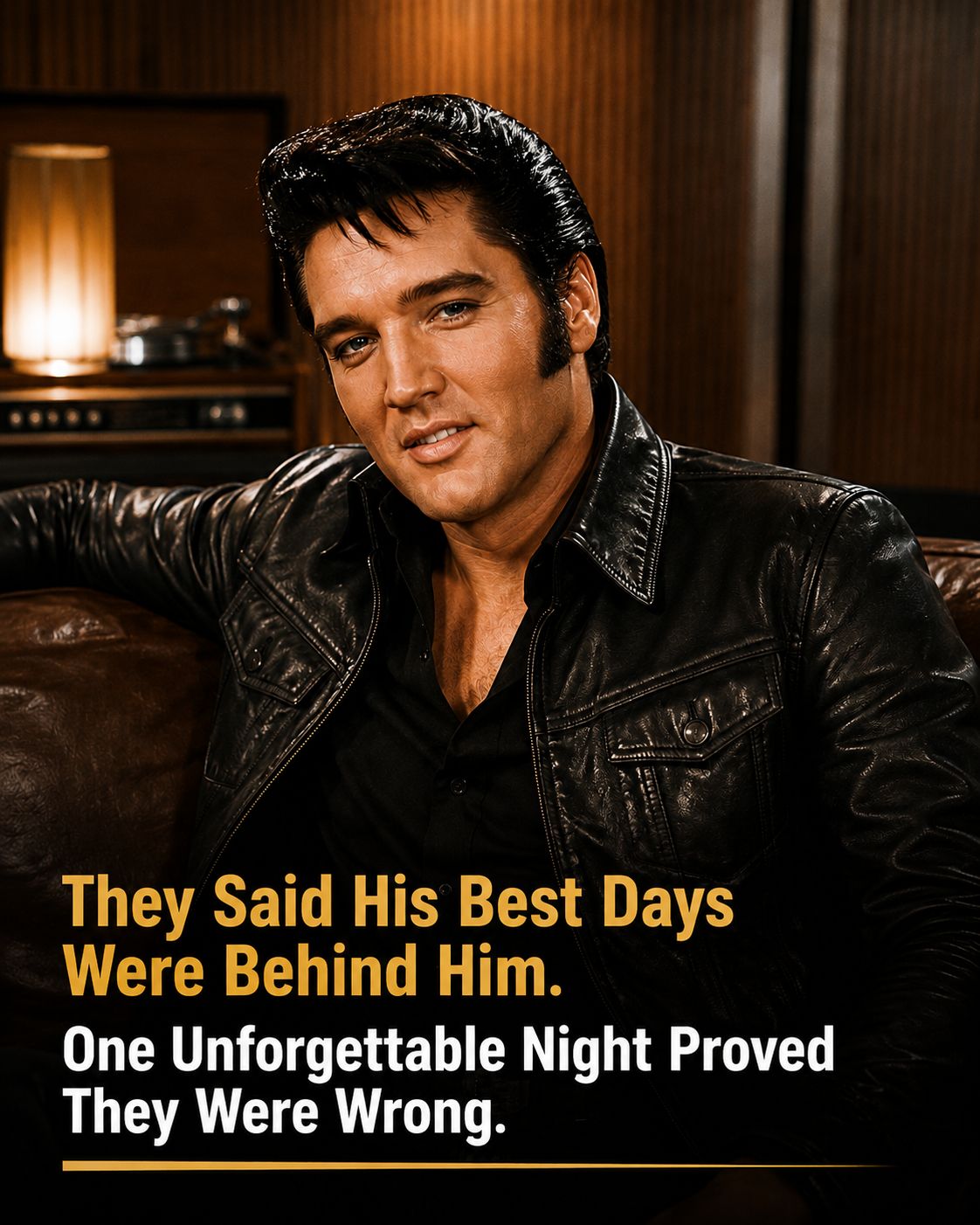
The leather suit.
The nervous smile.
The sweat forming under the studio lights.
The laughter exchanged with old bandmates.
Nothing felt rehearsed enough to lose its humanity.
That was precisely why it worked.
Instead of hiding behind elaborate costumes or cinematic spectacle, Elvis sat only a few feet from the audience. Cameras captured every expression. Every breath. Every playful grin.
For perhaps the first time in years, viewers weren’t watching a movie star.
They were watching the musician.
“Great performances aren’t built from flawless notes. They’re built from fearless honesty.”
One unforgettable sequence remains the heart of the special.
Gathered in an intimate circle with guitarist Scotty Moore and drummer D. J. Fontana, Elvis slipped naturally into the music that had first changed his life.
No elaborate stage.
No massive orchestra.
No expensive visual effects.
Just friends making music.
The chemistry was impossible to fake.
They laughed between verses.
They challenged one another.
They pushed songs forward with instinct rather than choreography.
It felt less like television and more like an invitation into history.
That relaxed “sit-down” session would later become one of the most copied formats in live music.
But nobody has ever duplicated its electricity.
Part of the magic came from uncertainty.
Elvis himself reportedly questioned whether audiences still cared.
Years of making formulaic films had damaged his artistic confidence. Public perception had shifted. Younger musicians seemed to dominate every conversation.
The King wasn’t merely performing.
He was fighting for relevance.
That emotional tension radiates through every frame.
When he launches into explosive rock numbers, it isn’t nostalgia.
It’s survival.
Each lyric sounds like a declaration.
Each movement seems determined to erase years of doubt.
“He wasn’t trying to reclaim yesterday. He was proving he still owned today.”
Perhaps that’s why modern viewers continue discovering the special.
Its emotional core isn’t about celebrity.
It’s about reinvention.
Everyone eventually faces moments when the world assumes their best days have passed.
Careers stall.
Dreams drift.
Confidence disappears.
The “’68 Comeback Special” reminds us that comebacks rarely begin with applause.
They begin with courage.
Elvis didn’t return because critics suddenly believed in him.
He returned because he finally believed in himself again.
That distinction matters.
Watching his confidence rebuild throughout the show is almost cinematic. Early smiles become wider. His movements grow looser. His voice becomes increasingly fearless.
By the final performances, something unmistakable has happened.
The uncertainty is gone.
The King has returned.
The impact extended far beyond television ratings.
Industry insiders suddenly saw Elvis differently.
Concert promoters realized audiences still desperately wanted him.
Recording sessions took on new urgency.
Within a short time, he would begin one of the most successful touring chapters of his career, leading directly toward unforgettable performances in Las Vegas and beyond.
Without the “’68 Comeback Special,” that remarkable second act may never have existed.
Its influence also reached future generations of artists.
Musicians studying stage presence continue examining those performances today. They notice how Elvis balanced vulnerability with confidence, humor with intensity, precision with spontaneity.
He reminded performers that technical perfection alone doesn’t create unforgettable entertainment.
Connection does.
Even viewers too young to remember 1968 often describe the special in remarkably similar language.
They don’t talk first about the set design.
They don’t mention camera angles.
They don’t praise wardrobe choices.
They say one simple thing:
“It felt real.”
That authenticity transcends generations.
Today’s digital landscape often rewards carefully managed images, polished branding, and calculated performances.
The “’68 Comeback Special” offered the opposite.
Imperfection.
Risk.
Emotion.
Humanity.
Ironically, those qualities made it timeless.
“Legends aren’t remembered because they never stumbled. They’re remembered because they stood back up.”
Perhaps the greatest lesson from the special has nothing to do with music at all.
Life has a way of convincing people they’ve already peaked.
That it’s too late.
That opportunities have disappeared.
That younger talent has replaced them.
Elvis walked into that television studio carrying every one of those doubts.
He walked out having rewritten his legacy.
His comeback wasn’t powered by nostalgia.
It was powered by authenticity.
He stopped trying to become what others expected.
Instead, he remembered who he had always been.
That’s why the “’68 Comeback Special” remains unforgettable.
Not because it resurrected a career.
Because it revealed a truth every generation needs to hear.
The world may occasionally forget greatness.
Greatness never forgets itself.
More than half a century later, those black leather clothes, that unmistakable smile, and those explosive performances continue reminding audiences why Elvis Presley was never simply another singer.
He became a cultural force because he possessed something impossible to manufacture—an instinctive ability to make every listener feel they were witnessing history unfold in real time.
And on one extraordinary television special in 1968, they truly were.
The King didn’t ask for his crown back.
He earned it all over again.
Video