Introduction
Television has produced countless unforgettable moments.
But only a handful have changed American culture forever.
On September 9, 1956, more than 60 million Americans tuned in to watch a young singer from Memphis make his first appearance on The Ed Sullivan Show. The audience expected excitement. They expected controversy. What they witnessed was the arrival of a cultural force unlike anything television had ever seen.
Just a few months later, during Elvis Presley’s third and final appearance on the program in January 1957, the cameras made a choice that would become one of the most discussed decisions in television history.
They showed him primarily from the waist up.
For generations, that image has fueled one enduring question:
Why would one of the biggest television shows in America deliberately hide part of its biggest star?
The answer reveals far more than a disagreement over camera angles.
It captures a nation struggling to decide whether it feared change—or simply couldn’t stop watching it.
“Sometimes history isn’t written by what the camera shows. It’s written by what the camera refuses to show.”
By 1956, Elvis Presley was no longer just a successful recording artist.
He had become a cultural phenomenon.
Teenagers screamed his name before he even reached the microphone.
Record stores struggled to keep his singles in stock.
Concert halls erupted into scenes of excitement that older generations found almost impossible to understand.
His music blended country, gospel, rhythm and blues, and rockabilly into something that felt entirely new.
But it wasn’t only the music that unsettled America.
It was the movement.
Elvis didn’t stand perfectly still behind a microphone.
He performed with energy.
His knees bent to the rhythm.
His legs moved instinctively.
His hips swayed with the beat.
To younger audiences, it looked exciting.
To many parents, religious leaders, and television commentators, it looked dangerous.
Newspapers criticized his performances.
Some writers described them as overly suggestive.
Others warned that he represented declining moral standards.
Television executives suddenly found themselves balancing two competing realities.
Millions wanted to see Elvis.
Millions of others were writing letters demanding that he be restrained.
“Every generation has an artist who makes the previous generation uncomfortable. Elvis became that artist for America.”
When Elvis first appeared on The Ed Sullivan Show in September 1956, the response was overwhelming.
The ratings were extraordinary.
Viewers could not look away.
Yet the criticism intensified almost as quickly as the applause.
Commentators debated whether his dancing belonged on family television.
Editorials questioned whether broadcasters should exercise greater restraint.
The controversy itself only increased public curiosity.
The more adults objected, the more teenagers wanted to watch.
Television had discovered something remarkable.
Elvis wasn’t merely entertaining audiences.
He was becoming the center of a national conversation.
By the time planning began for his final Sullivan appearance in January 1957, producers were acutely aware of the criticism.
The solution they chose has become legendary.
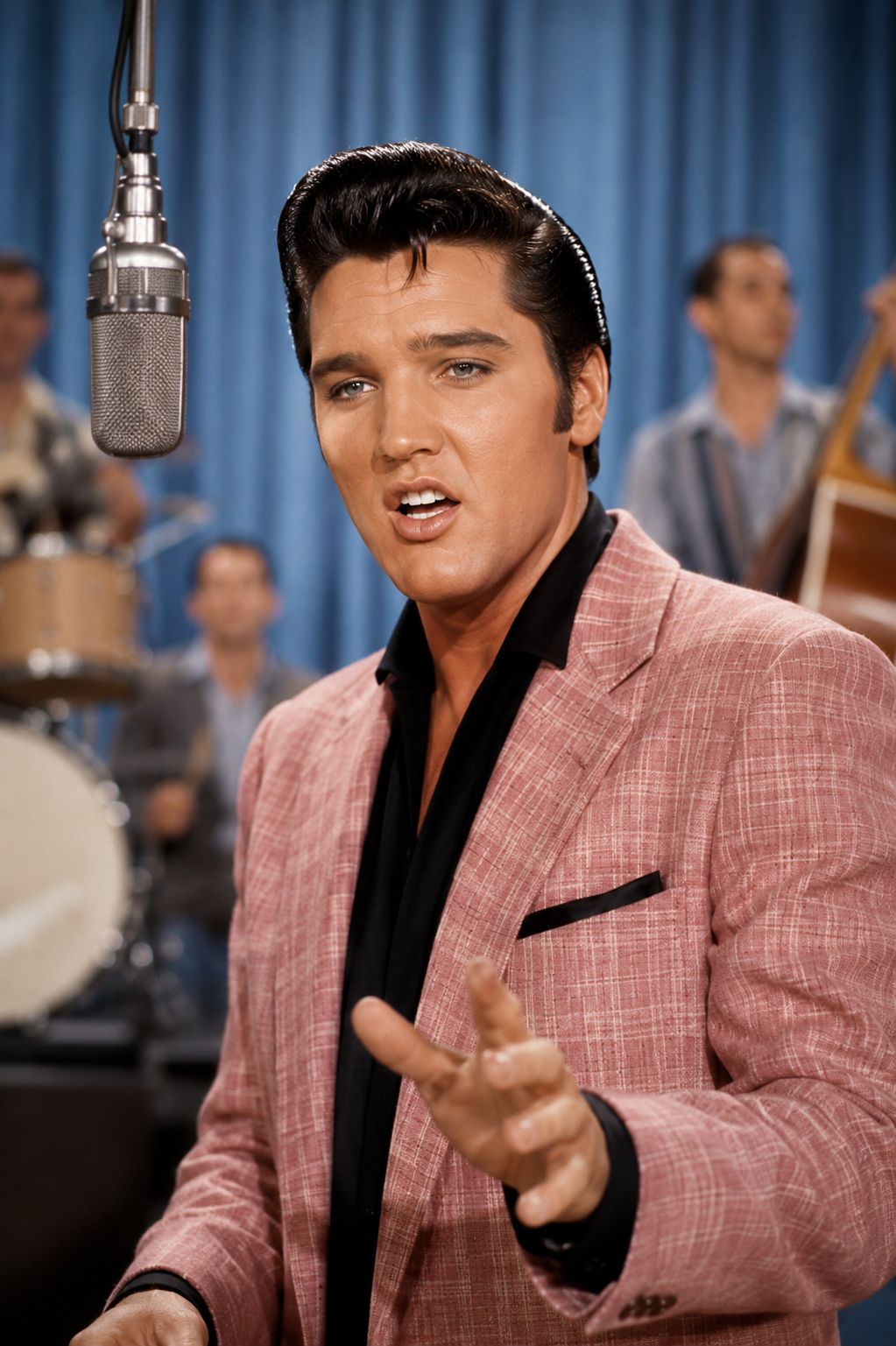
Camera framing emphasized Elvis from the waist up for much of the broadcast, minimizing the full-body movements that had generated so many complaints during earlier appearances.
It was, in essence, an attempt to satisfy two audiences at once.
Give viewers Elvis.
Reduce the source of controversy.
“They could limit the camera. They couldn’t limit the charisma.”
Ironically, the decision accomplished something few could have predicted.
Rather than diminishing Elvis’s impact, it amplified it.
Audiences already knew how he performed.
The public imagination filled in everything the cameras omitted.
The controversy surrounding the framing became a story in its own right.
Years later, the waist-up shots would become symbolic—not because they silenced Elvis, but because they demonstrated how difficult it had become to contain him.
The irony was unmistakable.
The network tried to soften his image.
Instead, it reinforced his reputation as a performer powerful enough to challenge the conventions of American television.
Country music fans often recognize another important dimension of this story.
Elvis never abandoned his musical roots.
Long before he became the King of Rock and Roll, he had absorbed country music from artists who filled Southern radio stations with heartfelt storytelling.
He admired gospel quartets.
He respected blues musicians.
He loved country singers.
His performances reflected that broad musical upbringing.
The movement that sparked controversy wasn’t carefully choreographed.
It was instinctive.
It grew naturally from the rhythm he heard.
“You can rehearse choreography. You cannot rehearse authenticity.”
Perhaps that explains why censorship proved so ineffective.
Television could crop the image.
It could not diminish the voice.
Listen to Elvis sing during those broadcasts.
Confidence radiates from every lyric.
Warmth fills every phrase.
Joy accompanies every smile.
Even without seeing every movement, audiences sensed remarkable freedom.
That freedom frightened some observers because it represented something much larger than entertainment.
The United States of the 1950s valued conformity.
Elvis represented individuality.
Young listeners saw permission to express themselves.
Parents often saw unpredictability.
Neither reaction existed in isolation.
Both reflected a nation undergoing rapid cultural change.
Television became the battlefield.
The camera became one of its most visible symbols.
“The argument was never really about dancing. It was about who would define the future.”
Today, it is easy to smile at the idea that a singer’s hip movements once generated nationwide controversy.
Modern audiences have witnessed performances far more provocative than anything Elvis presented in 1956 or 1957.
Yet judging history only through modern standards misses the point.
Elvis challenged expectations because he arrived during a different era.
His performances questioned assumptions about youth, music, race, and personal expression.
Those questions mattered profoundly.
The television debate reflected broader social anxieties.
Could popular culture change traditional values?
Should broadcasters shape public taste or simply reflect it?
Where should entertainment draw the line?
These discussions extended far beyond one singer.
Elvis simply became their most recognizable face.
Remarkably, he rarely responded with anger.
Those who knew him often described a courteous young man who respected others even when they criticized him.
He continued working.
Continued recording.
Continued performing.
The music remained his answer.
“History remembers the songs far longer than it remembers the complaints.”
Looking back nearly seven decades later, the waist-up broadcasts reveal something unexpectedly hopeful.
Despite every attempt to soften his impact, Elvis succeeded because audiences recognized sincerity.
His appeal never depended solely on movement.
It rested upon emotional connection.
Whether singing a tender ballad, an exuberant rockabilly number, or a heartfelt gospel hymn, he communicated genuine feeling.
That authenticity proved impossible to censor.
It also explains why those television appearances remain among the most studied performances in popular music history.
Students of broadcasting examine the camera work.
Historians analyze the cultural reaction.
Musicians admire the performances.
Fans simply enjoy watching Elvis be Elvis.
Perhaps the greatest irony of all is this:
The producers hoped careful camera angles would reduce controversy.
Instead, they created one of television’s most enduring legends.
People still discuss those broadcasts today.
Not because the cameras hid something.
Because the cameras unintentionally revealed something even greater.
They revealed the extraordinary power of an artist whose influence extended beyond every technical limitation placed before him.
The frame ended at his waist.
His impact did not.
Elvis Presley didn’t change America because audiences could see every dance step.
He changed America because every note he sang carried confidence, originality, and unmistakable authenticity.
The cameras captured only part of the man.
History remembered all of him.
And in the end, perhaps that is the most remarkable lesson of the controversial broadcast.
You can crop a television picture.
You cannot crop a cultural revolution.
Video
https://pie.yt/?v=https://youtu.be/31efeG0Pqe8?si=cQOD3ONEZmXL7GJ4&pieshare=1