Introduction
There are performers who wear costumes.
Then there are legends whose costumes become part of history.
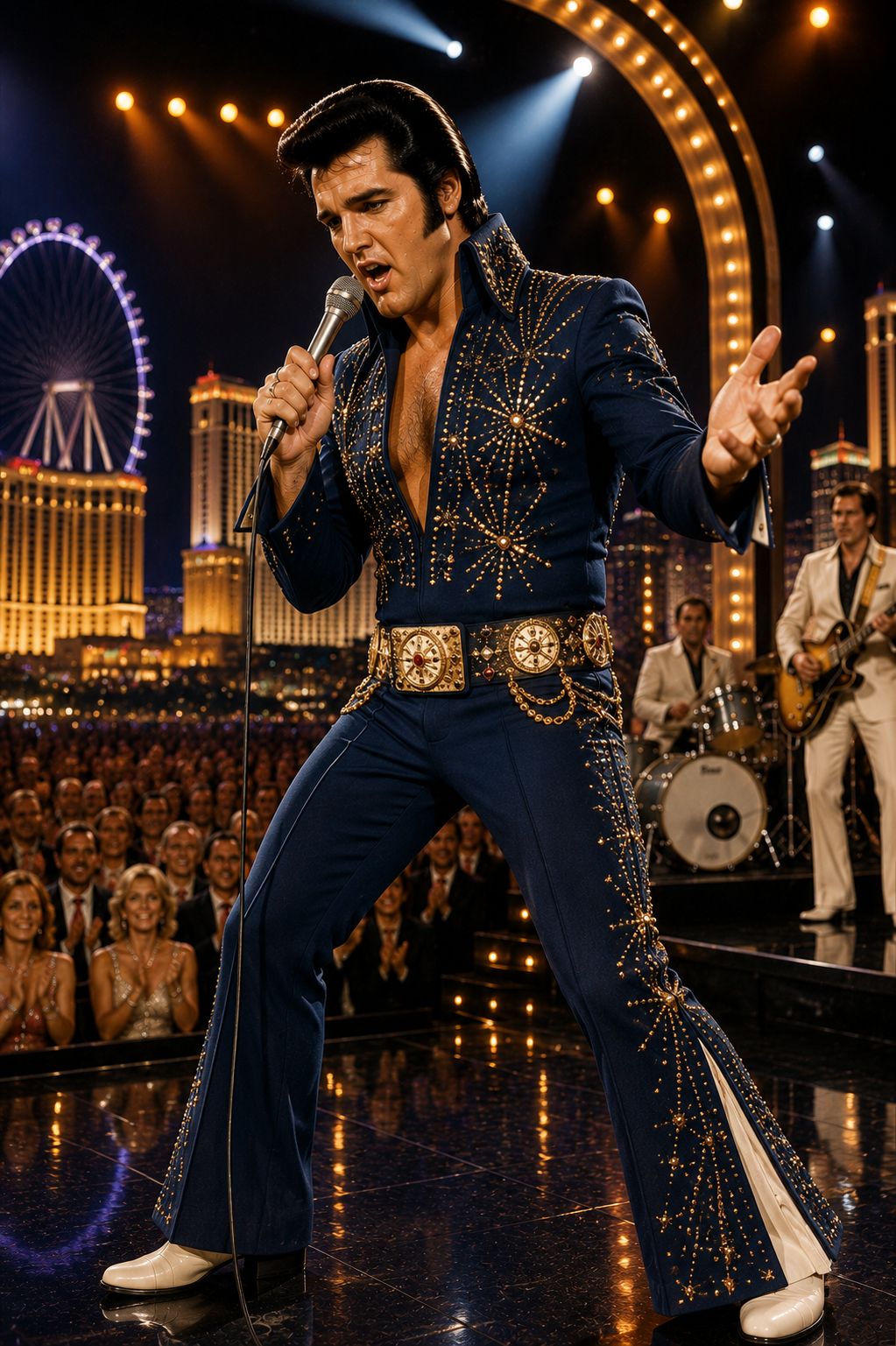
For Elvis Presley, the jeweled jumpsuits of his Las Vegas years weren’t merely stage outfits—they became visual symphonies. Every rhinestone reflected another flash of a camera. Every embroidered eagle spread its wings before thousands of screaming fans. Every sweeping cape transformed an already larger-than-life entertainer into something bordering on mythical.
Critics once dismissed those outfits as excessive.
History remembers them as masterpieces.
The Night Vegas Belonged to One Man
Las Vegas in the late 1960s and throughout the 1970s was filled with stars. Frank Sinatra ruled sophisticated lounges. Showgirls dazzled audiences beneath impossible lighting. Comedians, magicians, and crooners competed nightly for attention.
Then Elvis walked onto the stage.
The room instantly changed.
He didn’t simply enter under the spotlight.
He became the spotlight.
The jumpsuit was part of that transformation.
Unlike the tailored suits of his Hollywood years or the leather outfit from his legendary 1968 television comeback, the Vegas jumpsuit announced something entirely different. It declared confidence before Elvis sang a single note.
The audience knew immediately they were witnessing an event.
“The costume wasn’t hiding the man—it amplified the myth.”
Every entrance became theatrical.
Every movement created another sparkle.
Every turn sent thousands of crystals dancing beneath stage lights.
It wasn’t fashion.
It was choreography woven into fabric.
A Suit Built for Music
Most people remember the rhinestones.
Few appreciate the engineering.
Designer Bill Belew understood something many costume designers overlooked.
Elvis never stood still.
He lunged toward fans.
He karate-kicked across the stage.
He dropped to one knee.
He swung microphones.
He wrapped scarves around lucky audience members.
Traditional stage clothing would wrinkle, tighten, or restrict movement.
These jumpsuits did the opposite.
Stretch fabrics allowed complete freedom.
High collars elongated Elvis’ silhouette.
Bell-bottom legs exaggerated every dramatic stride.
Wide belts emphasized his athletic posture.
Long capes created unforgettable openings before being dramatically removed midway through performances.
Each detail served performance first and appearance second.
That combination proved revolutionary.
The Eagle That Soared Above Vegas
Among dozens of unforgettable designs, none captured public imagination like the American Eagle jumpsuit.
Its massive embroidered eagle spread across Elvis’ chest with breathtaking precision.
Gold, red, blue, and white gemstones shimmered under concert lighting, creating the illusion that the bird itself was alive.
Fans erupted before Elvis even touched the microphone.
The costume carried symbolism.
Strength.
Freedom.
Pride.
National identity.
When Elvis performed “An American Trilogy,” the eagle seemed almost to sing alongside him.
The visual and musical experience merged into one unforgettable moment.
“Some concerts are remembered by their songs. Elvis concerts are remembered by silhouettes.”
That silhouette became instantly recognizable across the world.
The Symphony of Movement
Watch surviving concert footage carefully.
Notice what happens during songs like “Polk Salad Annie.”
The jumpsuit almost becomes another instrument.
As Elvis twists his shoulders, gemstones scatter reflections across the stage.
When he raises both arms, embroidered sleeves resemble wings.
As the cape falls away, the audience erupts again—as though witnessing a second grand entrance.
The outfit isn’t static.
It performs.
Each movement creates visual rhythm matching the music itself.
Fast songs produce flashes of light.
Ballads allow audiences to admire every intricate detail.
The clothing breathes alongside the performance.
That’s why the phrase “jumpsuit symphony” feels appropriate.
The costume never distracted from the music.
It danced with it.
Critics Never Understood
During Elvis’ later years, some journalists mocked the increasingly elaborate outfits.
Too many rhinestones.
Too many colors.
Too much spectacle.
But audiences disagreed.
Night after night, thousands filled showrooms to witness precisely that spectacle.
What critics called excess became unforgettable branding decades before branding became entertainment’s favorite word.
Children drew Elvis wearing white jumpsuits.
Halloween costumes copied them.
Collectors searched endlessly for authentic replicas.
Museums proudly displayed originals.
Fashion designers borrowed their silhouettes.
Even modern pop superstars owe something to Elvis’ fearless theatrical style.
Sometimes greatness arrives dressed louder than its critics can tolerate.
Every Stone Reflected Confidence
There was another reason the jumpsuits mattered.
Elvis understood visual storytelling.
Large arenas required larger personalities.
Fans seated in the final rows deserved excitement equal to those sitting in front.
The brilliant embroidery ensured every audience member saw a star.
He respected every ticket holder.
No one left feeling they had watched an ordinary nightclub performance.
Instead, they witnessed spectacle worthy of the King of Rock and Roll.
That philosophy elevated Las Vegas entertainment forever.
Future residency performers—from rock icons to global pop stars—would embrace increasingly elaborate productions.
Elvis helped redefine what audiences expected.
More Than Fabric
Today, original Elvis jumpsuits command astonishing values among collectors.
Yet their true worth cannot be measured in dollars.
They represent ambition.
Risk.
Reinvention.
After Hollywood slowed and musical tastes shifted during the late 1960s, many wondered whether Elvis’ greatest years had passed.
Instead, he reinvented himself.
The jumpsuit became the uniform of that rebirth.
Each embroidered design whispered the same message:
“I’m still here.”
And audiences believed every word.
The Emotional Connection
Perhaps the most remarkable aspect wasn’t the clothing itself.
It was what audiences associated with it.
Couples remembered anniversaries celebrated during Vegas performances.
Families remembered their first Elvis concert.
Children remembered receiving scarves handed directly from the stage.
Photographs preserved those memories forever.
Whenever someone sees one of those famous jumpsuits today, they don’t simply remember fashion.
They remember where they were.
Who they loved.
How loudly they screamed.
How impossible it seemed that one performer could command an entire room so completely.
The jumpsuit became memory stitched into fabric.
The Legacy That Still Sparkles
More than four decades after Elvis’ final performances, the image remains timeless.
Mention Elvis Presley to almost anyone on Earth.
Many won’t picture the young truck driver from Memphis.
They won’t immediately picture the Hollywood actor.
Instead, they’ll imagine the white jeweled jumpsuit.
The dramatic cape.
The oversized belt.
The raised collar.
The microphone held triumphantly in one hand.
That single image captures confidence, charisma, and unmatched showmanship in one unforgettable frame.
Fashion trends come and go.
Stage productions evolve.
Technology transforms concerts.
Yet the visual power of Elvis’ Vegas era remains astonishingly modern.
Perhaps that’s because those famous jumpsuits were never just costumes.
They were declarations.
Declarations that music deserved grandeur.
That audiences deserved wonder.
That entertainment should leave people believing they had witnessed something impossible.
And every night the lights dimmed in Sin City, Elvis Presley proved exactly that.
The orchestra tuned.
The crowd roared.
The cape spread like wings.
The rhinestones ignited beneath the lights.
For a few unforgettable hours, Las Vegas didn’t simply host a concert.
It surrendered completely to the magnificent jumpsuit symphony that only Elvis Presley could conduct.