Introduction
Few artists have ever blurred the line between music and activism quite like Willie Nelson. To millions, he is the weathered troubadour with the unmistakable voice, the battered guitar named Trigger, and a catalog of timeless country classics. But behind the songs lies another story—one far more controversial. It is the story of a man who repeatedly found himself behind bars, not because he abandoned his principles, but because he refused to abandon them.
For decades, Willie Nelson became one of America’s most recognizable advocates for marijuana legalization. Long before public opinion shifted, before politicians cautiously embraced reform, and before dispensaries became commonplace in many states, Nelson was paying the personal price for speaking openly about cannabis.
His legal battles became headlines.
His arrests became symbols.
And his unwavering stance transformed him into one of the most unlikely political voices in country music.
“Sometimes history remembers the people who broke the rules—not because they loved breaking them, but because they believed the rules themselves were wrong.”
The Outlaw Who Never Pretended
Country music has always celebrated rebels.
Johnny Cash sang for prisoners.
Waylon Jennings challenged Nashville traditions.
Merle Haggard gave voice to forgotten workers.
But Willie Nelson took the outlaw image into real life.
Unlike celebrities who quietly hid their cannabis use behind expensive lawyers and carefully managed public relations teams, Nelson rarely denied it. In interviews, concerts, and television appearances, he openly discussed marijuana as part of his daily life.
That honesty made him a target.
Law enforcement agencies across multiple states repeatedly found themselves arresting one of the most beloved entertainers in America.
Yet every arrest seemed to strengthen rather than weaken his public image.
Fans weren’t shocked.
They almost expected it.
The Arrests That Became Legendary
Over the years, Nelson faced several marijuana-related arrests that became national news.
One of the earliest widely reported incidents occurred in the 1970s, helping establish his reputation as country music’s genuine outlaw. Later arrests followed in different states, each adding another chapter to an already colorful career.
Perhaps the most famous modern incident came in 2010.
Traveling through Texas, Nelson’s tour bus stopped at a Border Patrol checkpoint. Officers reportedly smelled marijuana, searched the vehicle, and discovered a small quantity of cannabis.
The result?
Willie Nelson was arrested—again.
For many artists, such an incident might have triggered panic.
For Willie, it became another unforgettable story.
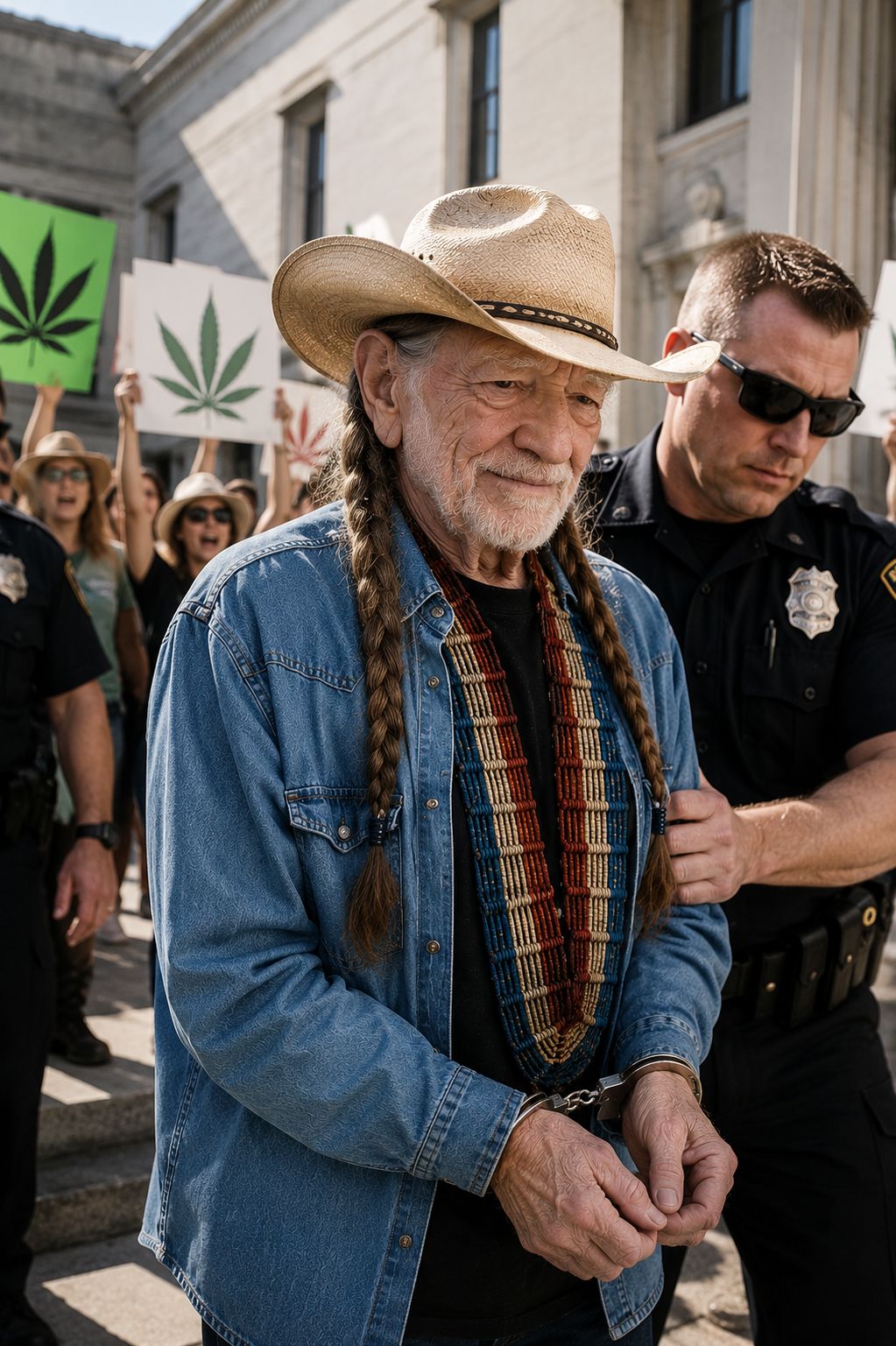
The image of an elderly country legend calmly dealing with another marijuana arrest spread across newspapers, television broadcasts, and social media.
It almost felt surreal.
Here was an American icon in his seventies, still making headlines for exactly the same cause he had championed for decades.
“He never tried to reinvent himself. He simply refused to apologize for who he already was.”
Public Opinion Begins to Change
Here’s where the story becomes remarkable.
When Nelson first spoke publicly in favor of marijuana legalization, much of America considered the idea radical.
Cannabis was widely portrayed as dangerous.
Politicians competed to appear “tough on drugs.”
Open advocacy carried enormous professional risk.
Country music, in particular, often appealed to conservative audiences.
Many advisors would have encouraged silence.
Many managers would have recommended distancing from controversy.
Willie Nelson chose the opposite.
Instead of backing away, he leaned into the conversation.
He argued that marijuana laws wasted public resources.
He questioned why adults should face criminal penalties for cannabis while alcohol remained legal despite its own societal harms.
Whether audiences agreed or disagreed, they rarely questioned his sincerity.
More Than Personal Freedom
Critics often assumed Nelson’s activism existed simply because he enjoyed smoking marijuana.
That interpretation missed the bigger picture.
Over time, Nelson increasingly framed legalization as an issue of criminal justice, medical research, personal liberty, and common sense.
He supported efforts to legalize medical cannabis.
He advocated for regulated markets rather than criminal underground economies.
He argued that enforcement disproportionately harmed ordinary people.
These arguments gradually entered mainstream political debate.
Ideas once dismissed as fringe slowly became subjects of legislative hearings and ballot initiatives.
Willie Nelson watched public opinion shift around him.
The man once mocked as an aging hippie suddenly looked surprisingly ahead of his time.
The Cost of Speaking First
History often celebrates pioneers.
It rarely remembers how uncomfortable pioneering actually is.
Every arrest carried consequences.
Legal expenses.
Embarrassing headlines.
Professional scrutiny.
Potential damage to endorsements.
Family concerns.
Tour disruptions.
Yet Nelson never appeared interested in carefully protecting his reputation through silence.
That authenticity resonated with fans.
Even people who opposed marijuana legalization often respected his consistency.
He wasn’t chasing headlines.
He wasn’t following trends.
He was saying essentially the same thing year after year.
Consistency became credibility.
Country Music’s Complicated Relationship
Willie Nelson’s legalization advocacy also challenged stereotypes about country music itself.
The genre has long reflected rural America, tradition, patriotism, and personal responsibility.
Some observers assumed those values automatically excluded support for marijuana reform.
Nelson complicated that narrative.
He demonstrated that love for country music, respect for American traditions, and support for legalization could coexist.
He never stopped singing classic country songs.
He never abandoned his roots.
He simply expanded the conversation.
In doing so, he opened doors for younger artists to speak more openly about issues once considered untouchable.
Vindication Through Time
Perhaps the most extraordinary part of Nelson’s story isn’t the arrests.
It’s what happened afterward.
Over the past two decades, state after state has legalized medical marijuana.
Many have legalized recreational cannabis.
Public opinion surveys now show majority support for legalization in much of the United States.
Political leaders from both major parties have acknowledged the need for reform.
Meanwhile, Willie Nelson remains exactly who he has always been.
The laws changed.
He largely didn’t.
That reversal gives his story unusual historical weight.
A man repeatedly arrested for advocating one position ultimately lived long enough to watch much of America move toward it.
“Sometimes the world doesn’t change because one person shouted louder. Sometimes it changes because one person refused to stop speaking.”
Beyond the Headlines
Reducing Willie Nelson’s activism to mugshots would miss the larger point.
His legacy isn’t built on arrests.
It’s built on resilience.
He absorbed criticism without bitterness.
He accepted legal consequences without abandoning his beliefs.
He managed to remain deeply beloved while standing at the center of one of America’s most divisive public policy debates.
Few entertainers accomplish that balance.
Even fewer maintain it across six decades.
The Lasting Legacy
Today, younger generations know Willie Nelson as a country legend.
Older generations remember the albums, the concerts, the Farm Aid benefit concerts, and Trigger’s unmistakable sound.
But history may ultimately remember something else.
It may remember an artist who repeatedly risked embarrassment, arrest, and criticism for an issue he believed mattered.
Whether one agrees with every aspect of marijuana legalization is almost beside the point.
The remarkable element is his refusal to disguise his convictions for convenience.
In an industry often driven by image management, Willie Nelson remained refreshingly impossible to manage.
His legal battles became chapters in a much larger American story—a story about changing cultural values, evolving laws, freedom of expression, and the unpredictable ways history judges those willing to stand apart.
The jail cells eventually became footnotes.
The headlines faded.
The debates continued.
But Willie Nelson’s reputation endured, not because he was arrested multiple times, but because every arrest reinforced the same unmistakable message: authenticity is difficult to manufacture, impossible to fake, and sometimes powerful enough to outlast the very laws that once punished it.