Introduction
History rarely announces itself.
The moments that change the world often begin quietly—with a single song, a single chance, a single voice waiting to be heard.
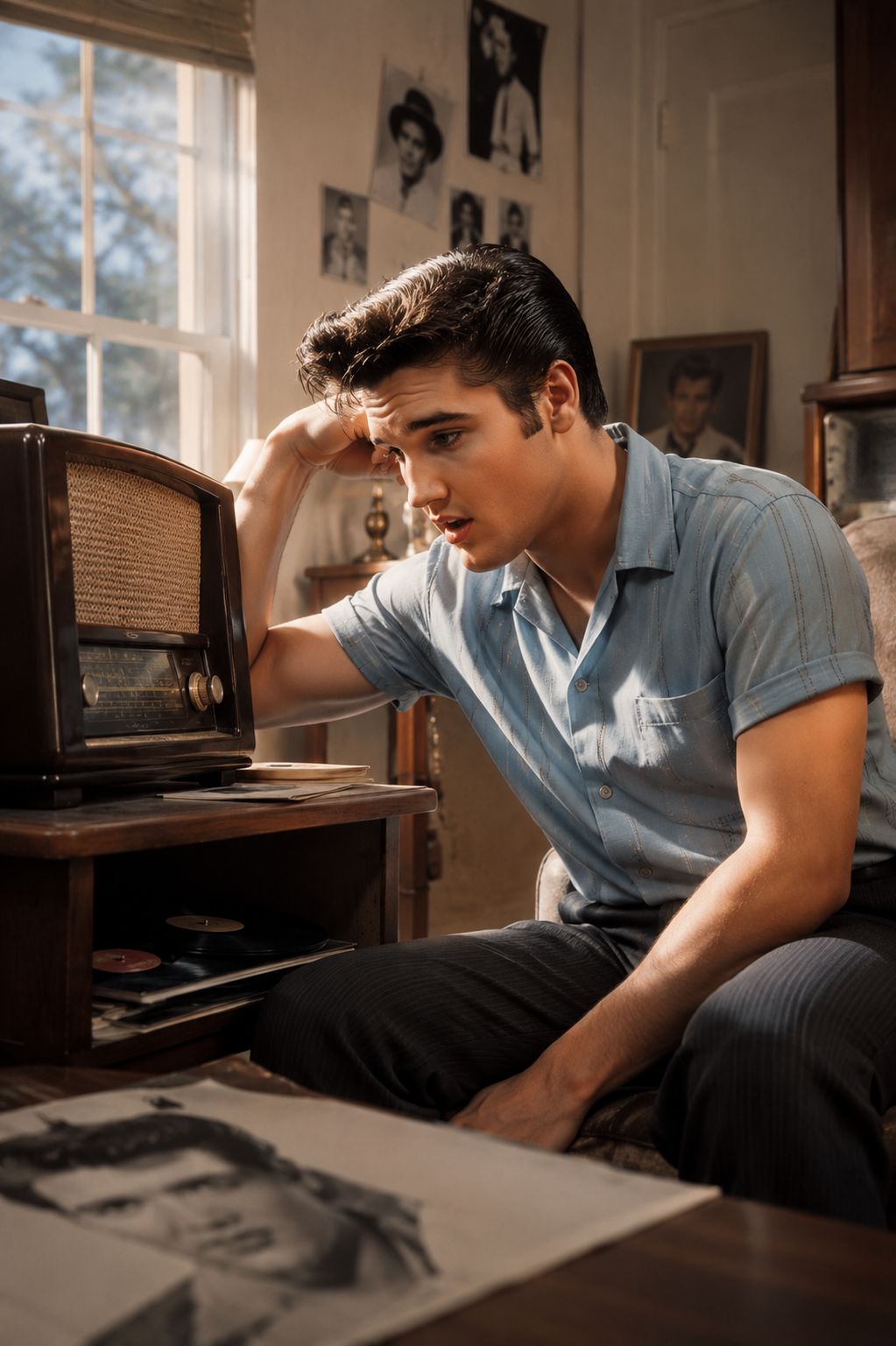
For Elvis Presley, that moment arrived during the scorching summer of 1954, when an unassuming recording called “That’s All Right” found its way onto a Memphis radio station.
No one—not the disc jockey, not the small team at Sun Records, not even Elvis himself—could have predicted what would happen next.
Within hours, a shy 19-year-old truck driver from Memphis would discover that his life had changed forever.
The King had not yet been crowned.
But destiny had already knocked on the studio door.
“Sometimes history begins with a record spinning at 45 revolutions per minute.”
In July 1954, Elvis was still an unknown singer chasing an impossible dream.
He had grown up in modest circumstances, absorbing gospel in church, country on the radio, and rhythm and blues wherever he could find it.
To some, those influences seemed incompatible.
To Elvis, they were simply music.
When producer Sam Phillips invited him into Sun Studio, he wasn’t searching for another polished vocalist.
He was searching for something different.
Something honest.
Something that couldn’t be easily categorized.
That breakthrough finally arrived during an informal recording session when Elvis, guitarist Scotty Moore, and bassist Bill Black began playing Arthur Crudup’s blues song “That’s All Right.”
The performance wasn’t meticulously planned.
It wasn’t carefully engineered.
It felt spontaneous.
Alive.
Phillips immediately sensed that something extraordinary had just happened.
The recording carried the emotional directness of country music, the pulse of rhythm and blues, and an energy unlike anything dominating American radio.
It didn’t fit neatly into any existing category.
That was precisely its strength.
“The greatest revolutions often sound unfamiliar the first time we hear them.”
Soon afterward, the acetate reached influential Memphis disc jockey Dewey Phillips, who played the song repeatedly on his popular radio program.
The reaction was immediate.
Telephone lines lit up.
Listeners called in asking one question after another.
Who is this singer?
Where did he come from?
Can you play that record again?
Again.
And again.
No elaborate marketing campaign had prepared the audience.
No national publicity machine had introduced Elvis Presley.
The music did the work.
People heard something they had never heard before.
They wanted more.
But while listeners flooded the station with requests, Elvis wasn’t celebrating.
According to accounts from those involved, he had become so nervous after learning about the response that no one could immediately find him.
Rather than waiting confidently for fame to arrive, the young singer reportedly went to a local movie theater, hoping to escape the anxiety surrounding the broadcast.
Imagine the contrast.
Inside the theater sat an unknown teenager trying to disappear into the darkness.
Outside, an entire city was suddenly trying to find him.
Eventually, Sam Phillips and others tracked Elvis down and brought him to the radio station for an interview.
It was an unforgettable moment.
The shy young performer who had quietly walked into Sun Studio now faced microphones, questions, and a future changing faster than he could fully comprehend.
“While America searched for its newest voice, that voice was hiding in a movie theater.”
The story has become legendary because it reveals something deeply human.
Elvis wasn’t expecting instant stardom.
He wasn’t rehearsing acceptance speeches.
He wasn’t imagining headlines.
He was overwhelmed.
Like countless young dreamers, he hoped someone might appreciate his music.
He never imagined the response would arrive so suddenly.
During the interview, Dewey Phillips wisely avoided one question he knew audiences were wondering.
At the time, many listeners could not tell whether the singer was Black or white—a reflection of how unusual Elvis’s musical style sounded in the segregated America of the 1950s.
Instead, Phillips casually asked Elvis which high school he had attended, allowing listeners to infer his background without directly addressing race.
It was a subtle moment, but an important one, revealing how Elvis’s music challenged long-standing assumptions about genre, influence, and audience.
“Great music doesn’t ask permission to cross boundaries. It simply does.”
By the end of that remarkable evening, Elvis Presley was no longer just another aspiring musician.
Word had spread rapidly across Memphis.
Local interest became regional curiosity.
Regional curiosity soon became national fascination.
Within weeks, performances attracted larger crowds.
Within months, his reputation continued growing.
Within two years, he would become one of the most recognizable entertainers in the world.
Looking back, it is tempting to view that first radio broadcast as inevitable.
History rarely feels inevitable while it is unfolding.
At the time, no one knew whether “That’s All Right” would become a local novelty or the beginning of something much larger.
The music industry itself was changing.
Country music remained deeply rooted in tradition.
Rhythm and blues was reaching new audiences.
Young listeners were searching for voices that reflected a rapidly changing America.
Elvis unknowingly arrived at precisely the right cultural moment.
His gift wasn’t simply his remarkable voice.
It was his ability to bring different musical traditions together without diminishing any of them.
He loved gospel.
He admired country storytelling.
He respected blues musicians.
Rather than choosing between those influences, he embraced them all.
The result sounded revolutionary.
Yet to Elvis, it felt natural.
“The artists who change music are often the ones who never believed its borders were real.”
Country music historians sometimes describe this period as one of the genre’s most fascinating crossroads.
Although Elvis would become internationally associated with rock and roll, his foundation remained unmistakably Southern.
His phrasing reflected country tradition.
His emotional honesty echoed gospel.
His rhythm honored blues.
That combination reshaped American popular music.
It also broadened country music’s own reach by demonstrating how deeply connected these traditions truly were.
What happened in the hours after that first radio broadcast wasn’t merely the launch of a successful career.
It marked the beginning of a cultural transformation.
Fans sensed authenticity before they recognized celebrity.
They responded not to image but to emotion.
That distinction explains why Elvis continues attracting new listeners generations later.
Technology evolves.
Recording techniques improve.
Musical styles change.
Authenticity never becomes obsolete.
Perhaps the most moving aspect of the story is its simplicity.
There were no fireworks.
No grand announcements.
No carefully orchestrated publicity stunt.
A record played on the radio.
Listeners called the station.
A nervous young singer hid in a movie theater.
Then everything changed.
“Destiny rarely arrives with fanfare. More often, it arrives while someone is wondering whether anyone will even notice.”
As Elvis’s career soared, that unforgettable day became one of the defining stories of his remarkable journey.
Not because it guaranteed success, but because it revealed the character of the young man standing at the edge of history.
He remained humble enough to doubt himself.
Passionate enough to keep singing.
Brave enough to embrace a sound no one else had imagined.
The applause would come later.
The sold-out arenas.
The gold records.
The television appearances.
The global fame.
All of it began with one song and one extraordinary afternoon in Memphis.
When “That’s All Right” first echoed through radio speakers in 1954, audiences heard a fresh voice.
Elvis Presley heard the beginning of uncertainty.
Neither realized they were listening to the birth of a legend.
By nightfall, the unknown truck driver had become the most talked-about young singer in Memphis.
Within a few short years, he would become the King of Rock and Roll.
And it all began with a simple truth that still resonates today:
One song can change a life.
One broadcast can change a career.
And one unforgettable afternoon can change music forever.