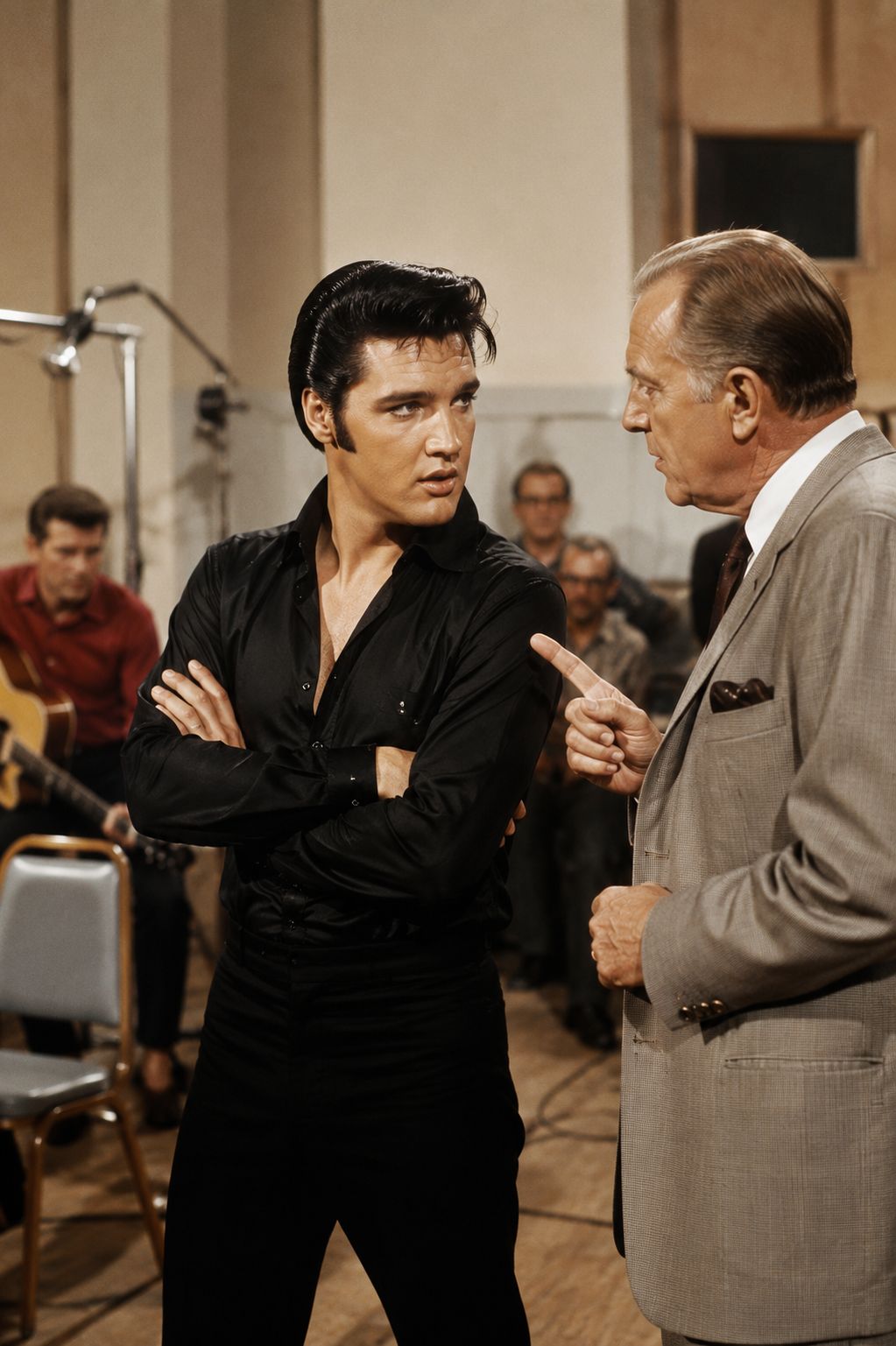
Introduction
Some revolutions begin with protest.
Others begin with a whisper.
For Elvis Presley, one of the greatest artistic revolutions of his career began with a simple but daring decision:
He refused to let someone else decide who he had become.
By the summer of 1968, Elvis Presley stood at a crossroads unlike any he had faced before.
Only a decade earlier, he had changed popular music forever. His explosive blend of country, gospel, rhythm and blues, and rockabilly had electrified young audiences around the world.
But the years that followed looked very different.
Hollywood musicals dominated his schedule.
Formulaic movie soundtracks gradually replaced the raw energy that had first made him a sensation.
Critics wondered whether the rebel who once shocked America had become trapped inside his own success.
Even some devoted fans feared the same.
Then came the television special that would rewrite the story.
Today it is remembered simply as the ’68 Comeback Special.
But what audiences ultimately witnessed almost never happened.
“Sometimes the greatest comeback isn’t returning to the spotlight. It’s returning to yourself.”
Colonel Tom Parker had guided Elvis’s career with remarkable commercial success.
Their partnership had transformed an unknown Memphis singer into one of the world’s biggest entertainers.
Yet by 1968, their visions were not always aligned.
Early concepts for the NBC television special reportedly emphasized a polished, family-friendly holiday program with Christmas elements and carefully controlled performances.
From a business standpoint, the idea seemed safe.
Predictable.
Comfortable.
Safe television.
But Elvis sensed something was missing.
Not spectacle.
Truth.
He knew audiences didn’t simply miss seeing him.
They missed the artist who had once performed with fearless spontaneity.
The young man who sang as though every note mattered.
The performer whose energy couldn’t be contained by elaborate sets or scripted dialogue.
If this special was going to matter, it couldn’t merely remind audiences that Elvis Presley still existed.
It had to remind them why they had fallen in love with him in the first place.
“An artist can survive criticism. What becomes impossible is surviving without authenticity.”
Director Steve Binder quickly recognized the same opportunity.
Rather than presenting Elvis as another polished television personality, Binder encouraged him to reconnect with his musical roots.
The idea was radical.
Strip away the elaborate production.
Forget the movie costumes.
Put Elvis in black leather.
Seat him among fellow musicians.
Let the songs breathe.
Let the conversations happen naturally.
Most importantly…
Let Elvis be Elvis again.
The concept wasn’t universally embraced.
It challenged expectations.
It carried genuine risk.
No one could guarantee audiences would respond.
Yet Elvis increasingly believed this was the direction the special needed to take.
The legendary sit-down sessions emerged from that creative courage.
Musicians gathered in an intimate circle.
Friends laughed between songs.
Stories unfolded naturally.
Mistakes remained.
So did smiles.
Nothing felt manufactured.
Everything felt alive.
“Perfection impresses people. Honesty changes them.”
Those now-iconic performances became the emotional heart of the special.
Watching the footage today, one remarkable detail immediately stands out.
Elvis looks free.
Not constrained by choreography.
Not limited by fictional movie characters.
Simply a musician rediscovering the joy of making music.
His confidence grows visibly from one performance to the next.
The grin returns.
The playful humor returns.
Most importantly…
The fire returns.
That transformation could never have been achieved through a carefully scripted holiday variety show alone.
It required vulnerability.
It required trust.
And it required Elvis’s willingness to push for something more authentic than the original concept envisioned.
Perhaps that was the true act of defiance.
Not rebellion for its own sake.
But refusing to accept a version of himself that no longer felt genuine.
“Real courage isn’t doing the unexpected. It’s doing what feels true when the easier path lies directly ahead.”
The sit-down sessions also reminded audiences of something they had almost forgotten.
Before the films…
Before Las Vegas…
Before global superstardom…
There had been a young musician from Memphis who loved singing simply for the joy of singing.
Country.
Gospel.
Blues.
Rockabilly.
Every influence flowed naturally together once again.
No category contained him.
No formula defined him.
The special became less about nostalgia than renewal.
Elvis wasn’t trying to recreate 1956.
He was proving that his artistry still possessed extraordinary depth.
The audience responded immediately.
Critics praised the performances.
Fans celebrated the return of the Elvis they remembered.
A younger generation discovered him for the first time.
One of the evening’s defining moments arrived with the powerful performance of “If I Can Dream.”
Inspired by the turbulence and hope of the era, the song carried a message of unity, compassion, and possibility.
It departed from the predictable ending some had expected.
Instead of simply entertaining viewers, Elvis delivered a performance filled with conviction and emotional urgency.
Standing beneath dramatic lighting, dressed in white, he sang with unmistakable intensity.
The closing lines echoed far beyond the television studio.
They became a declaration that Elvis Presley remained not only relevant, but artistically fearless.
“Every great comeback begins the moment an artist stops asking what people expect and starts asking what the music deserves.”
The success of the special transformed the next chapter of Elvis’s career.
Within months, he returned to live performances.
Soon came the celebrated Las Vegas engagements.
Concert tours expanded.
Recording sessions gained renewed energy.
The comeback wasn’t merely commercial.
It was creative.
He had rediscovered confidence.
That confidence reached audiences in every performance that followed.
Looking back, it is tempting to reduce the story to one dramatic confrontation between Elvis and Colonel Parker.
History is usually more complicated.
Their relationship combined loyalty, disagreement, commercial success, and differing creative instincts.
The special evolved through the contributions of many people—Elvis, Steve Binder, producers, musicians, writers, and yes, Colonel Parker as well.
But one truth stands above every interpretation.
Elvis embraced the opportunity to reclaim his artistic voice.
That decision altered the special forever.
Perhaps that is why the 1968 Comeback Special continues inspiring musicians across genres.
It reminds artists that commercial success means little if authenticity disappears.
It demonstrates that audiences recognize sincerity immediately.
Technology changes.
Television evolves.
Production values improve.
Yet nothing replaces genuine emotion.
Country music has always understood that lesson.
The finest country songs succeed because they tell the truth.
Elvis carried that same philosophy into the comeback that redefined his career.
Behind every unforgettable performance stood a man determined to reconnect with the music that first changed his life.
The black leather suit became iconic.
The intimate jam sessions became legendary.
The final performance became timeless.
But beneath every memorable image lived one essential decision.
Elvis chose authenticity over comfort.
He chose creative honesty over predictable safety.
He chose to trust the music.
And in doing so, he reminded the world that legends are not defined by how long they remain famous.
They are defined by the moments they find the courage to become themselves again.
The 1968 Comeback Special was never simply a television program.
It was a turning point.
A rediscovery.
A declaration that the rebellious spirit who had once transformed American music had never truly disappeared.
He had simply been waiting for the right stage, the right songs, and the right moment to remind the world exactly who Elvis Presley had always been.
Video
https://youtu.be/0qBIu2EhQQc?si=K7euyCp46FyxhjaU