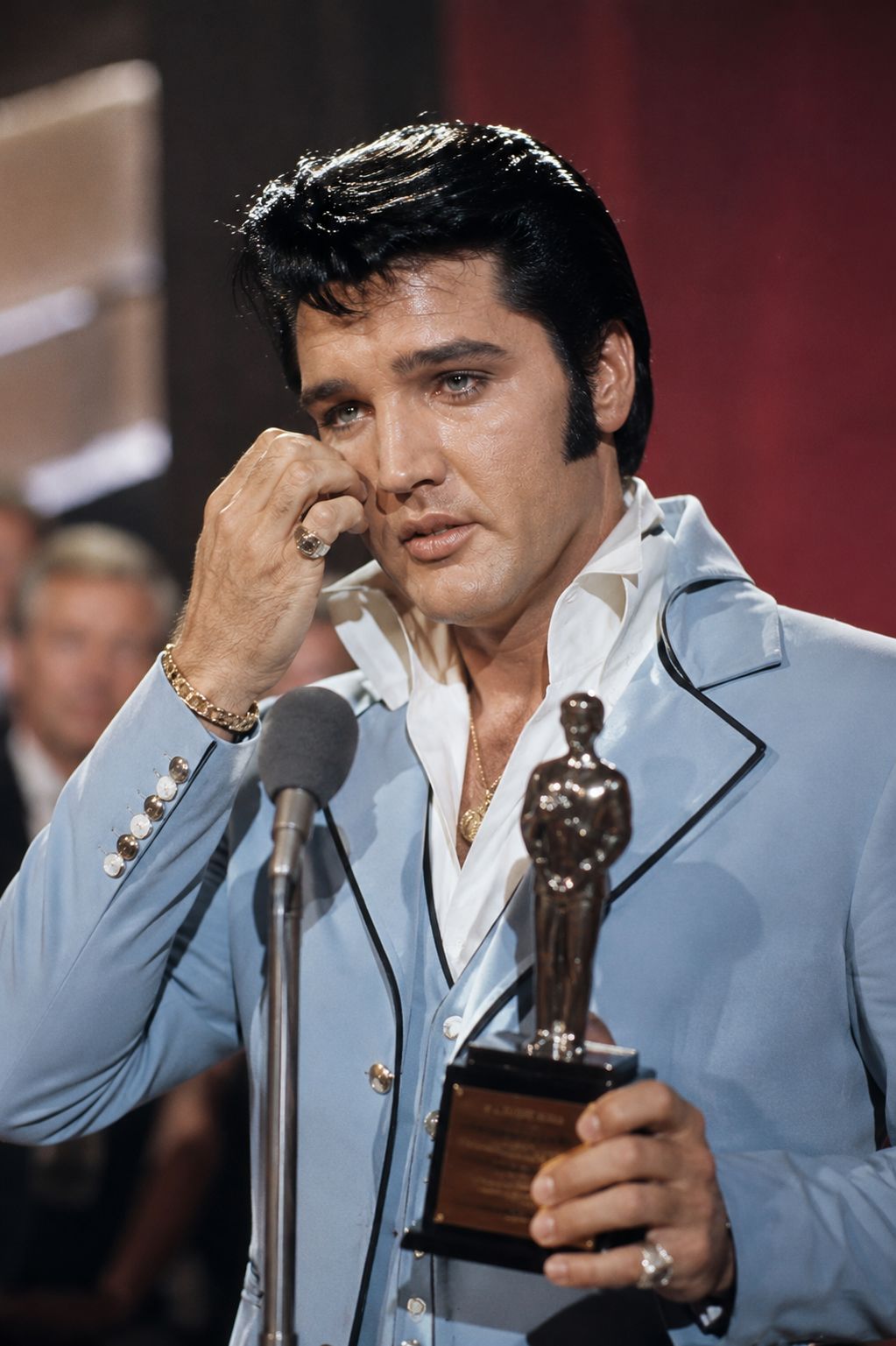
Introduction
Some speeches celebrate achievement.
Others reveal character.
When Elvis Presley stepped to the podium on January 16, 1971, to accept recognition as one of the Ten Outstanding Young Men of the Nation, America expected gratitude.
Few expected vulnerability.
The world already knew Elvis as the King of Rock and Roll.
Millions had watched him transform popular music.
They had seen the screaming crowds.
The gold records.
The Hollywood films.
The triumphant return of the 1968 Comeback Special.
Yet on that evening, the audience encountered something far more memorable than another celebrity accepting another award.
They met a man reflecting on the responsibility that accompanied extraordinary success.
“The greatest acceptance speeches are rarely about the award. They’re about the journey that made the award possible.”
By 1971, Elvis Presley had already lived several remarkable lives within a single career.
There was the shy teenager from Tupelo, Mississippi.
The truck driver from Memphis chasing a musical dream.
The young recording artist who shocked America with “That’s All Right.”
The global superstar who became the face of rock and roll.
The soldier who fulfilled his military service.
The entertainer who rediscovered his artistic fire during the 1968 Comeback Special.
Each chapter had brought applause.
Each chapter had also brought criticism.
For nearly two decades, Elvis had learned that fame could be both a blessing and a burden.
On this night, however, none of those headlines mattered.
What mattered was the opportunity to speak—not as an icon, but as a person.
“Behind every legend lives someone who still remembers where they came from.”
The Jaycees award honored achievement, leadership, and positive contributions to society.
Its previous recipients represented excellence in many fields.
For Elvis, receiving such recognition carried special meaning.
This was not an award based solely on record sales.
It acknowledged influence.
Character.
Citizenship.
Those distinctions mattered deeply to him.
When he began speaking, listeners noticed something different.
There was no swagger.
No attempt to dominate the room.
Instead, Elvis spoke with humility.
One line in particular has echoed through history:
**”When I was a child, ladies and gentlemen, I was a dreamer. I read comic books, and I was the hero of the comic book. I saw movies, and I was the hero in the movie. So