Introduction
History often remembers the biggest concerts for the songs that were performed.
But sometimes, a concert changes history not because of the music that fills the arena—but because of what the music makes possible.
For Elvis Presley, one of the most meaningful performances of his entire career wasn’t designed to promote a new record, launch a film, or top the charts.
It was organized for a very different purpose.
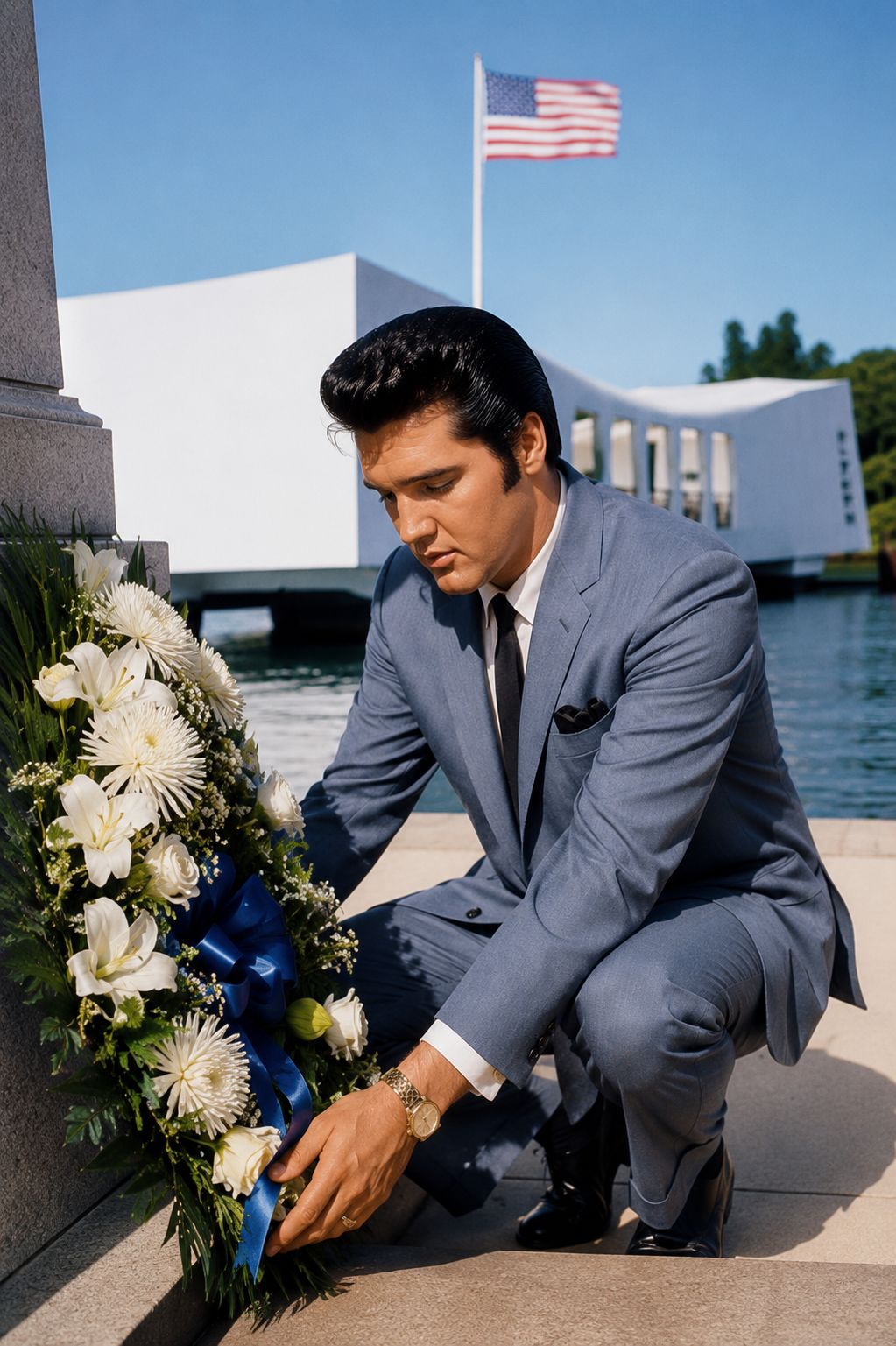
To help ensure that America would never forget the men who lost their lives at USS Arizona Memorial.
Over the decades, headlines have sometimes exaggerated the story, claiming that Elvis “single-handedly saved” the memorial.
The reality is both more nuanced—and, in many ways, even more inspiring.
The USS Arizona Memorial was the result of years of effort by veterans, military leaders, private citizens, and government officials. Yet Elvis’s 1961 benefit concert proved to be the decisive catalyst that generated the money and public attention needed to move the long-delayed project toward completion.
Without countless others, the memorial would not exist.
Without Elvis’s extraordinary intervention at exactly the right moment, it might have remained unfinished for much longer.
“Sometimes one performance becomes more than entertainment. It becomes an act of remembrance.”
Nearly twenty years had passed since the devastating attack on Pearl Harbor on December 7, 1941.
The battleship USS Arizona still rested beneath the waters of Pearl Harbor, serving as both a grave for more than 1,100 sailors and Marines and a solemn reminder of a day that forever changed American history.
Plans for a permanent memorial had been discussed for years.
People cared deeply.
But caring and funding are not always the same thing.
Money came slowly.
Construction stalled.
The vision remained incomplete.
Many feared that a proper national tribute might never become reality.
Meanwhile, Elvis Presley stood at a very different crossroads.
After serving in the U.S. Army from 1958 to 1960, he had returned to civilian life with enormous popularity.
Hollywood films filled his schedule.
His records continued selling in remarkable numbers.
He had become one of the world’s most recognizable entertainers.
Few would have blamed him for focusing exclusively on his career.
Instead, an unexpected request arrived.
Could Elvis help raise money for the memorial?
The answer would become one of the defining examples of his generosity.
“The greatest stars shine brightest when the spotlight is aimed at someone else.”
On March 25, 1961, Elvis took the stage at Bloch Arena in Hawaii.
It was no ordinary concert.
Every ticket purchased represented more than admission.
It represented participation in preserving history.
The audience understood that.
So did Elvis.
Unlike many benefit events, this concert carried extraordinary symbolic weight.
A young man who had recently completed military service was now performing to honor Americans who had made the ultimate sacrifice.
The connection felt deeply personal.
Throughout the evening, excitement filled the arena.
Fans screamed.
Applause thundered.
Yet beneath the energy remained another emotion.
Gratitude.
Everyone present knew they were witnessing more than entertainment.
They were helping write another chapter in the story of Pearl Harbor.
“Music cannot rewrite history. But it can help preserve the memory of those who lived it.”
The concert proved remarkably successful.
It raised more than $50,000 for the memorial fund—a substantial amount in 1961—and, just as importantly, generated renewed national attention for a project that had struggled to secure sufficient financial support.
Newspapers covered the event.
Public interest increased.
Momentum returned.
Additional contributions followed.
Government and private support strengthened.
Construction advanced.
Several years later, the USS Arizona Memorial officially opened to the public in 1962.
That sequence of events explains why Elvis’s role has become legendary.
He did not build the memorial himself.
He did not design it.
He did not fund it alone.
What he provided was something equally valuable.
A turning point.
Sometimes every worthy project reaches a moment when it needs one influential voice capable of inspiring thousands of others to act.
In 1961, Elvis became that voice.
“Leadership isn’t always measured by doing everything yourself. Sometimes it’s measured by inspiring everyone else to help.”
The benefit concert also revealed another side of Elvis Presley that could easily be overlooked beneath the glamour of superstardom.
He understood gratitude.
Military service had shaped him profoundly.
Although already famous before entering the Army, Elvis chose to serve as a regular soldier rather than seek special treatment.
That experience strengthened his appreciation for those who wore the uniform before him.
Supporting the Pearl Harbor memorial therefore represented more than charity.
It reflected respect.
Respect for sacrifice.
Respect for history.
Respect for those who never returned home.
These values resonated deeply with audiences across America.
Country music fans, in particular, have long admired artists who remain connected to service, patriotism, and community.
Elvis embodied those traditions even while helping redefine popular music.
His success never erased his Southern upbringing or the values instilled during childhood.
“Character is revealed most clearly when applause is no longer the goal.”
Looking back today, it is tempting to focus exclusively on Elvis’s celebrity.
Yet perhaps the more remarkable story belongs to the people gathered inside Bloch Arena.
Every fan who purchased a ticket became part of something larger than themselves.
Veterans attended.
Military families attended.
Young admirers attended.
Together, they transformed one evening of music into lasting remembrance.
The concert demonstrated an enduring truth.
History is preserved not only by governments and institutions.
It is preserved by ordinary people willing to support extraordinary causes.
Elvis simply provided the spark.
Thousands carried the flame.
That lesson remains just as relevant today.
Monuments do more than commemorate the past.
They teach future generations.
Visitors who stand above the resting place of the USS Arizona encounter more than architecture.
They encounter silence.
Reflection.
Sacrifice.
The realization that freedom often carries an immeasurable cost.
Without sustained public commitment, places like these can struggle for recognition and preservation.
The 1961 benefit concert reminds us that artists possess remarkable influence beyond the stage.
A song can entertain.
A concert can inspire.
A single evening can help protect history.
“Legacies are built not only by the records we sell, but by the causes we choose to support.”
Elvis never seemed interested in claiming sole credit for the memorial’s success.
Those who worked alongside him understood that the project belonged to many hands.
Veterans campaigned tirelessly.
Community leaders organized.
Donors contributed.
Architects designed.
Construction crews built.
The memorial emerged because thousands believed the fallen deserved a permanent tribute.
Elvis’s gift was arriving when hope needed reinforcement.
His name drew attention.
His performance drew crowds.
His generosity drew renewed commitment.
That combination helped transform a worthy dream into a completed national memorial.
Perhaps that is why the story continues resonating more than six decades later.
Not because Elvis “single-handedly” saved the USS Arizona Memorial.
History is rarely the work of one individual.
Rather, because one of the world’s biggest entertainers willingly used his fame for something far greater than fame itself.
He stepped onto a stage not to celebrate his own achievements, but to honor the memory of others.
In doing so, he demonstrated that true greatness extends beyond chart-topping records and sold-out performances.
It is found in moments when influence becomes service, celebrity becomes responsibility, and music becomes a bridge between generations.
The applause inside Bloch Arena eventually faded.
The lights dimmed.
The audience went home.
But the impact of that evening endured.
Today, millions of visitors continue to stand in quiet reflection above the USS Arizona, remembering those who gave everything.
Among the many people whose efforts made that place possible, Elvis Presley’s benefit concert remains one of the most inspiring chapters—a reminder that sometimes a single night of music can help ensure that a nation’s memory will never be forgotten.